Introduction
Artificial intelligence is now central to digital transformation, but the loudest idea in the market may also be the riskiest. Many teams are told to go “AI-first” before they know what problem they need to solve. That is why CTOs are uneasy. A smart ai strategy does not begin with trendy models or giant budgets. It begins with outcomes, workflows, and clear business value. If you want AI to work, you need integration first and hype last.
Understanding AI-First Architecture in Enterprise Technology
In enterprise technology, ai-first architecture means embedding AI into core systems, data flows, and workflow automation instead of treating it like a side tool. It lets machine learning and related ai systems support decisions, trigger actions, and assist teams inside normal work.
That sounds powerful, and it can be. Still, business value appears only when AI connects to enterprise applications, enterprise data, and business processes. The next sections explain what this first architecture means, why it is growing fast, and how it differs from older automation models.
Defining AI-First Architecture and Its Role in Modern Enterprises
At its core, ai-first architecture is the practice of building AI into enterprise systems so it can take part in day-to-day work. It is not just a dashboard, chatbot, or isolated model. It is a first architecture approach where AI uses enterprise data, reads signals from connected platforms, and supports actions inside real business processes.
In modern companies, that often means linking AI with CRM tools, ERP platforms, contact centers, case management systems, and knowledge management repositories. AI can then guide employees, route work, or support decisions without forcing people to leave the tools they already use.
The role is simple but important. AI should help the business operate, not sit outside it. When it is integrated well, it turns insights into action, cuts manual processes, and supports better business outcomes across departments.
Why the “AI-First” Movement Is Gaining Momentum
The movement is growing because companies want more than basic automation. They want systems that can learn, adapt, and improve decisions. Machine learning, generative ai, and large language models make that idea feel possible at scale, especially as digital transformation pushes every team to move faster.
There is another reason. Businesses now manage huge amounts of structured and unstructured data. Leaders see AI as a way to turn that information into useful actions, not just reports. They want faster responses, smarter recommendations, and stronger customer experiences across many business functions.
Still, momentum does not equal maturity. Many organizations are adopting AI in at least one area, but far fewer have scaled it across the enterprise. That gap shows why ai strategy must focus on integration, governance, and workflow design rather than model hype alone.
The Shift From Traditional Automation to AI-First Workflow Integration
Traditional automation follows rules. It is useful for repetitive tasks, but it usually stops when conditions change. That is why many companies are moving beyond traditional automation toward workflow integration that lets ai systems react to context, data changes, and business events.
This shift matters because AI can do more than execute a script. With predictive analytics, AI can detect patterns, guide next steps, and support informed decisions across business functions. It can help with customer support, forecasting, prioritization, and routing while staying connected to the systems where work happens.
For businesses, the change starts with one question: should AI sit on top of work, or inside it? Outcome-focused teams choose the second option. They connect AI to workflows, add human oversight, and build feedback loops so performance improves over time.
Why CTOs Are Becoming More Cautious About Enterprise AI
Two years ago, the conversation in boardrooms centered on “How quickly can we deploy AI?” Today, the question has shifted to “How do we ensure AI delivers measurable business value?”
This change reflects a growing sense of pragmatism among CTOs. While enthusiasm for AI remains high, technology leaders are increasingly recognizing that successful AI adoption depends less on choosing the most advanced model and more on integrating AI into existing business processes.
Recent industry research from Deloitte, McKinsey, Gartner, and IBM paints a consistent picture: the biggest obstacles to AI success are no longer model performance—they are organizational, operational, and architectural. Enterprises are struggling to scale pilots, prove return on investment, manage governance, and integrate AI with legacy systems.
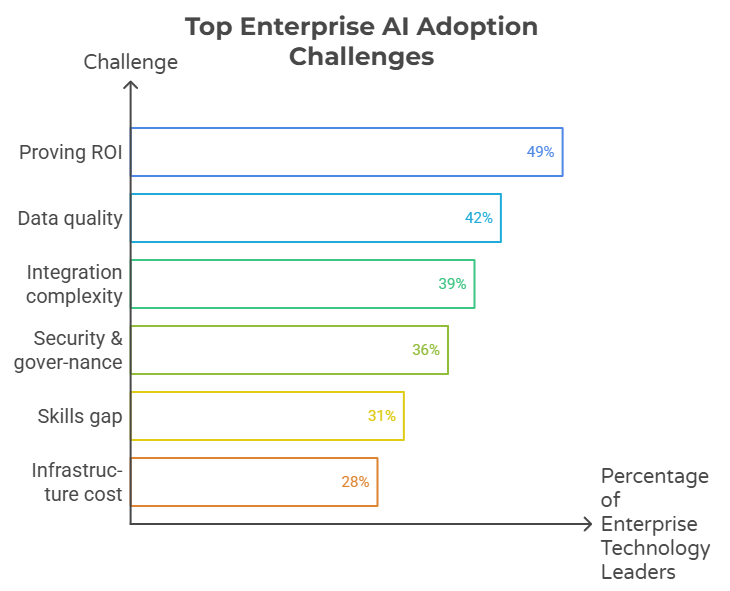
Top Challenges Holding Back Enterprise AI Adoption
Common barriers reported by enterprise technology leaders across major industry surveys.
Proving ROI Is Harder Than Expected
The biggest concern for today’s CTO isn’t whether AI works—it’s whether it generates measurable business value. Many organizations successfully launch AI pilots but struggle to translate them into enterprise-wide financial impact.
According to Deloitte’s research, most organizations expect AI investments to pay off quickly, yet the majority report that meaningful ROI typically takes two to four years to achieve. Only a small percentage recover their investment within the first year. Similarly, McKinsey found that while AI delivers measurable improvements at the individual use-case level, only
CTO takeaway: AI projects should be measured against business outcomes such as reduced processing time, lower operational costs, higher customer satisfaction, or increased revenue—not simply model accuracy.
Governance Has Become a Board-Level Priority
As AI systems begin making recommendations, generating content, and supporting business decisions, governance has become a strategic necessity rather than a compliance exercise.
Organizations now need clear policies for:
- Responsible AI usage
- Human oversight
- Model monitoring
- Regulatory compliance
- Third-party AI risk management
Deloitte’s latest enterprise AI research shows that mature organizations are investing heavily in governance frameworks because sustainable AI adoption depends on transparency, accountability, and measurable business outcomes—not experimentation alone.
Security Risks Extend Beyond Cybersecurity
Modern AI systems introduce new attack surfaces that traditional security frameworks were never designed to handle. Prompt injection attacks, unauthorized access to sensitive data, model misuse, and AI-powered social engineering have become genuine enterprise risks.
Security leaders must now protect not only infrastructure but also AI models, data pipelines, APIs, and autonomous workflows. As AI becomes deeply embedded in core business processes, security must be incorporated into the architecture from the outset rather than added later.
Integration Complexity Is the Real Bottleneck
Many organizations discover that the AI model itself is the easiest part of the project. The real challenge lies in connecting AI with CRMs, ERPs, document management platforms, legacy databases, approval workflows, and internal APIs.
Even highly accurate AI models generate limited value if they operate in isolation. Gartner advises technology leaders to prioritize high-value use cases with flexible integration strategies instead of pursuing large, monolithic AI initiatives that are difficult to scale.
This is why workflow integration—not model selection—has become the defining factor in enterprise AI success.
The AI Skills Gap Continues to Slow Deployment
Building enterprise AI requires more than prompt engineering. Organizations need professionals who understand system architecture, data engineering, security, governance, API integration, change management, and business process optimization.
As demand for these multidisciplinary skills grows faster than supply, many enterprises struggle to move beyond successful proofs of concept into production-ready AI systems. The result is a growing backlog of AI initiatives that never achieve enterprise scale.
The Outcome-First Approach: A Smarter AI Adoption Strategy
An outcome-first approach starts with business strategy, not model shopping. It asks what result matters most, what workflow needs help, and where human expertise should stay in control. That makes ai adoption more useful and far less wasteful.
It also changes the development process. Instead of forcing AI into every problem, you select use cases where integration can improve speed, quality, or cost. In the next sections, you will see why outcome-first thinking is often the safer and smarter path.
What Is Outcome-First Thinking and How Does It Differ?
Outcome-first thinking begins with business needs. You define the problem, the target result, and the workflow impact before choosing tools. That is different from an AI-first push that starts with a model and then hunts for a purpose.
This mindset keeps ai strategy grounded in business objectives and measurable business outcomes. It also protects the human element. Teams decide where AI should assist, where human oversight stays essential, and where no AI is needed at all.
Key differences include:
- Outcome-first starts with business objectives, not technology trends.
- It measures success through business outcomes, not model novelty.
- It fits AI into workflows that matter to users and operations.
- It respects business needs and human judgment from the start.
That is why outcome-first planning usually creates stronger adoption and less wasted spend.
Advantages of Modular Digital Engineering for AI Integration
Modular digital engineering gives you flexibility. Instead of betting everything on one giant platform or one expensive model, you build ai integration in pieces that can connect, scale, and change over time. That is a much safer path for enterprise teams.
In software development, this often means API-first and event-driven patterns, reusable services, microservices, and clear layers for data, applications, workflows, and monitoring. A modular technology stack reduces lock-in and makes it easier to connect AI with CRM, ERP, customer support, and other systems.
The biggest advantage is practical control. You can test one use case, improve it, and expand without rebuilding everything. If a model changes, your whole architecture does not break. That is why Techwink Services should push modular digital engineering over oversized AI purchases with weak integration plans.
How Outcome-First Strategies Reduce Costs and Maximize ROI
Outcome-first strategies cut waste because they focus spending where AI can change results. You avoid huge investments in tools that never reach production. Instead, you connect smaller efforts to clear business value, cost reduction, and operational gains.
This also improves roi. When ai adoption is tied to business models, workflows, and user behavior, leaders can measure what changed. Faster decisions, fewer manual steps, and stronger consistency are easier to track than abstract model scores.
Common ROI benefits include:
- Lower implementation costs through phased rollout
- Better reuse across workflows and teams
- Reduced duplication of tools and effort
- Faster time to measurable business value
- Stronger fit between AI adoption and business models
If you want high ROI, stop buying prestige. Start building outcomes.
Beginner’s Guide to Getting Started With Enterprise AI Integration
Getting started with enterprise ai does not require a giant leap. It requires clear integration choices. Your first goal is to connect AI to business processes and one useful ai workflow where better timing, quality, or action would matter.
From there, build the basics: data access, system connectivity, governance, and team support. Keep the scope tight and the outcome visible. If you want a practical starting point for your architecture, Claim Your Complimentary 5-Point AI Integration Review. The next sections cover the tools, technologies, and people you need.
What You Need: Tools, Skills, and Resources for AI Workflow Integration
A successful ai workflow needs more than a model. It needs the right tools, the right people, and enough structure to move from pilot to production. Most failures happen because one of those pieces is missing.
Start with practical resources:
- API-based connectors for core systems and data sources
- Workflow orchestration tools that support automation and escalation
- Data science skills for model selection, testing, and monitoring
- Security and governance controls for access, auditability, and compliance
- Observability tools for tracking performance and feedback loops
- Business owners who understand the process being improved
You do not need a huge team on day one. You need a strong foundation. That means technical skill, workflow knowledge, and clear accountability. When those pieces work together, AI becomes part of operations instead of another disconnected experiment.
Key Technologies and Solutions for Seamless AI Adoption
Seamless AI adoption depends on connected technologies, not isolated purchases. The strongest setups let AI move across systems, data, and workflows without creating more friction. That is why architecture matters as much as the model itself.
Useful building blocks include:
- Cloud computing for scalable AI workloads and flexible deployment
- Data platforms that unify enterprise data across structured and unstructured sources
- Predictive analytics tools for forecasting, scoring, and decision support
- Natural language processing for document handling, search, and conversational tasks
- Connectors for enterprise applications like CRM, ERP, and contact center tools
These solutions work best when they are aligned with business needs. A tool is only valuable if it helps AI trigger actions, guide employees, or improve customer experiences. Keep that standard high, and your adoption path stays much cleaner.
Building a Cross-Functional Team for Successful Integration
AI integration works best when it is not owned by one silo. You need a cross-functional team that includes technical staff, operations leaders, business owners, and people who understand day-to-day work. That mix keeps the plan realistic.
Human expertise matters at every stage. Technical teams handle architecture and deployment, but business functions define the real problem, the right workflow, and the desired outcome. Without that input, AI may be technically sound and still useless in practice.
The role of leadership is to align priorities, remove blockers, and support change management. Employees need clarity on what AI will automate, what stays human-led, and how success will be measured. When teams are involved early, resistance drops and adoption improves.
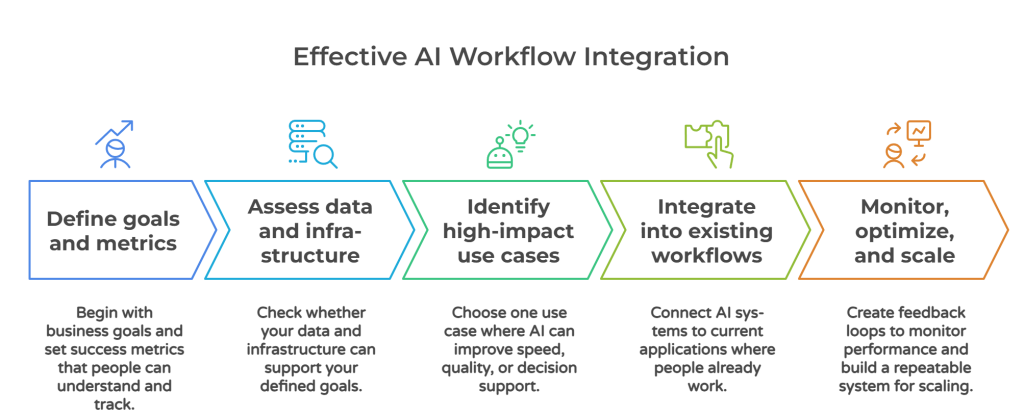
Step-by-Step Guide to Effective AI Workflow Integration
An effective ai workflow does not appear by accident. It comes from a sequence of smart decisions around data, systems, people, and metrics. Good integration ties those pieces together so AI supports business outcomes instead of creating more technical noise.
If you want best practices that hold up in real operations, keep the approach simple. Start with goals, confirm readiness, choose the right use case, and build inside existing workflows. The steps below offer a practical ai strategy for doing that well.
Step 1: Define Your Business Goals and Success Metrics
Begin with business goals, not features. What needs to improve? Is it response time, routing quality, cost, consistency, or employee productivity? Your ai initiative should support one defined business strategy outcome before it expands anywhere else.
Next, set success metrics that people can understand and track. If the goal is faster service, measure cycle time. If the goal is better decisions, measure accuracy or action speed. Tie metrics to workflow results, not vague technical promises.
Data collection supports this step. You need a baseline before AI goes live, or you will not know what changed. Clear metrics also help leadership decide whether to scale, adjust, or stop the effort. That discipline saves money and keeps the project honest.
Step 2: Assess Data Readiness and Infrastructure
Once goals are set, check whether your data and infrastructure can support them. AI depends on accurate, timely, and governed information. If enterprise data is fragmented, outdated, or poorly controlled, outputs will be weak no matter how advanced the model looks.
Focus on a few basics first:
- Review data quality across critical data sources
- Confirm access rules, governance, and lineage
- Check whether infrastructure supports real-time and batch execution
- Identify gaps between current systems and workflow needs
This step is where many projects should slow down. That is a good thing. Strong data readiness protects the business from poor results, broken trust, and expensive rework. It is better to fix the foundation early than scale a flawed setup later.
Step 3: Identify High-Impact Use Cases for AI Adoption Strategy
Now choose one use case with clear impact. The best starting point is not always the most exciting idea. It is the area where AI can improve speed, quality, or decision support without creating huge operational risk.
Strong candidates often share these traits:
- Clear workflow boundaries and visible pain points
- Direct connection to operational efficiency
- Enough usable data to support testing and monitoring
- Measurable effect on customer experiences or internal performance
- Relevance to current business models and priorities
This is where strategy becomes practical. A smart ai adoption plan picks use cases that can prove value early, build trust, and expand later. Start small, learn fast, and avoid projects that sound impressive but cannot change outcomes in real operations.
Step 4: Integrate AI Into Existing Workflows
This is the step that most determines success. AI must enter the workflow where people already work. If users need to switch tools, copy results, or guess what to do next, adoption falls fast. Good workflow integration keeps AI useful and usable.
Make this practical by focusing on:
- Connecting ai systems to current applications through APIs or events
- Embedding prompts, recommendations, or actions inside existing screens
- Designing handoffs between automation and human review
- Planning around legacy systems instead of pretending they do not exist
This matters a lot in customer support, service operations, and back-office tasks. AI should reduce friction, not add another layer of it. Workflow automation only creates value when the right output reaches the right person or system at the right time.
Step 5: Monitor, Optimize, and Scale Your AI Solutions
Launching AI is the start, not the finish. Business operations change, data shifts, and user behavior evolves. That is why monitoring must be built in from the beginning. You need visibility into model outputs, workflow impact, and user response.
Create feedback loops that show what is working and what is not. Watch performance, track exceptions, review quality, and capture employee input. Those signals help teams make informed decisions about tuning, retraining, or adjusting process design.
This is the heart of continuous improvement. A strong ai strategy does not aim for one perfect release. It builds a repeatable system for learning and scaling. When monitoring is active, expansion gets easier, safer, and far more likely to produce lasting business value.
Conclusion
In conclusion, navigating the complexities of AI-first architecture requires a nuanced understanding of both the technology and its integration within existing workflows. By adopting an outcome-first approach, organizations can not only mitigate risks but also optimize their investments in AI technologies. This strategic mindset fosters efficiency and maximizes returns on investment, allowing companies to leverage AI seamlessly while addressing key concerns such as ROI, security, and integration challenges. If you’re ready to take the next step and ensure your AI efforts are successful, claim your complimentary 5-point AI integration review today. It’s time to transform your approach and secure a competitive edge in the rapidly evolving tech landscape.
Contents
Frequently Asked Questions
Most frequent questions and answers
A well-designed ai workflow reduces repetitive tasks and helps business operations move faster and more consistently. It should not remove human oversight where judgment matters. Instead, it supports employees with better timing, clearer guidance, and improved service quality that can raise customer satisfaction.
Best practices include starting with business goals, checking data quality, choosing one high-value use case, and integrating AI into existing workflows. Strong ai strategy also needs change management, monitoring, and continuous improvement so teams can learn, adjust, and scale without creating unnecessary risk.