Introduction
Enterprise AI often starts with excitement, a fast demo, and big expectations. Then the AI initiative stalls. Why? Because a polished prototype is not the same as a working product tied to business outcomes. Many teams mistake early model output for real AI success, but AI adoption only grows when systems perform with live data, real users, and measurable value.
That challenge is becoming more important as organizations move from experimentation toward enterprise-wide deployment. McKinsey’s recent research on moving AI from adoption to impact highlights that simply increasing AI usage does not automatically translate into lasting enterprise value.
If you want better results, you need to look past the demo and ask what it takes to operate every day in production environments
.Understanding the 90-Day PoC Trap in Enterprise AI
The 90-day PoC trap happens when an enterprise ai team spends months building a proof of concept that only answers one question: can the model produce a good response? That may help an ai initiative win attention, but it does not prove business value.
In practice, the ai project gets stuck between demo and deployment. Long-term success suffers because data, cost, reliability, and ownership were never tested under real operating conditions. The next sections show where that gap begins.
Why Enterprise AI Initiatives Get Stuck at the Proof of Concept Stage
Most teams build an AI project to show possibility, not readiness. The proof of concept runs on clean samples, limited prompts, and a small test group. That setup can look strong, yet it says very little about enterprise data or day-to-day operating pressure.
Another issue is unclear ownership. When AI adoption is led mainly by technical teams, the work can drift toward model experiments instead of a business problem with measurable business value.
Then the real blockers appear: fragmented systems, poor data quality, integration complexity, and missing AI governance frameworks.
Organizations can use the AI Risk Management Framework from NIST as a reference for managing risks throughout the design, development, deployment, and use of AI systems.
The Difference Between a PoC Demo and a Production-Ready Solution
A PoC demo proves that something can work once. A production-ready AI solution must work for many users, at all hours, with messy inputs and steady performance.
In a demo, data quality problems stay hidden because the sample is sanitized and small. In a live AI system, scanned files, missing metadata, inconsistent formats, and retrieval errors affect every response.
There is also a shift in responsibility. A demo needs little monitoring, no rollback procedures, and almost no operational controls.
Production demands all three, plus security review, logging, observability, and cost discipline.
Microsoft’s guidance on AI observability specifically emphasizes evaluation, monitoring, tracing, latency, token consumption, errors, and quality throughout the AI application lifecycle.
The Sandboxed Illusion: Data Reality in Enterprise AI
A sandbox can make weak foundations look strong. In many pilots, the model works on static files inside an isolated notebook, so leaders assume the hard part is done.
It is not.
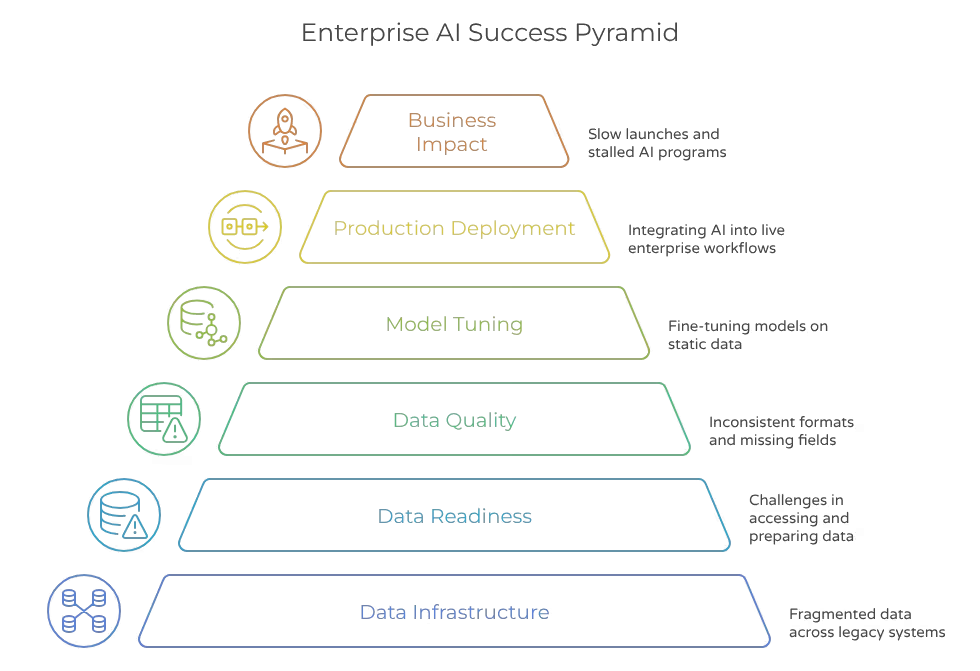
Real enterprise data is fragmented across legacy systems, warehouses, and streaming tools. That creates data readiness and data quality problems long before model tuning matters.
Google Cloud’s reference architecture for RAG infrastructure for generative AI demonstrates how production architectures may need ingestion from applications, databases, and streaming services before data is indexed and made available to an AI application.
Static CSVs vs. Fragmented Live Data Pipelines
Generative AI PoCs often appear easier than older machine learning pilots because you can connect an API and get fluent answers fast.
That speed creates a false sense of progress.
The production gap becomes obvious when a static CSV turns into a live data pipeline spread across multiple data platforms and legacy systems.
One clean file in a notebook does not reflect what happens in a company where records live in separate tools and arrive in inconsistent formats.
Static demo inputs hide broken joins, stale records, and missing fields.
Live systems expose scanned documents, unindexed content, and conflicting sources.
Weak retrieval and chunking choices quietly reduce answer quality in production.
For enterprise applications using retrieval-augmented generation, Google Cloud explains that RAG combines retrieval systems with large language models to produce responses grounded in external data.
That is why sanitized prototypes can pass while real implementations break.
Legacy Systems and Data Workflow Challenges
Many enterprise failures follow the same pattern. The team focuses on model behavior while ignoring the data infrastructure that feeds the ai system. Once connected to real workflows, old databases, document stores, and disconnected applications create friction everywhere.
Legacy systems also complicate data governance. The same customer, contract, or transaction may appear in different formats across business processes. Without standard metadata, version control, and trusted ingestion rules, the model receives incomplete context and produces weaker answers.
This is not just a technical nuisance. It affects how the business operates. When data governance is inconsistent, teams cannot trace where outputs came from or fix recurring errors quickly. That pattern leads to slow launches, low confidence, and stalled enterprise ai programs after the initial excitement fades.
The Hidden Costs of AI PoCs
At first glance, an AI project can seem cheap. A proof of concept uses light traffic, shared tools, and short-term engineering time.
The production gap changes everything.
Once usage grows, token spend, retries, cache misses, infrastructure costs, and support overhead can erase any path to cost reduction.
AWS guidance for generative AI inference architecture recommends detailed production cost modeling, including query volume, token usage, model pricing, infrastructure, vector databases, and guardrails.
Calculating True Inference Costs and Unit Economics
A strong demo on an unmetered API key tells you almost nothing about unit economics. To judge whether an ai initiative can survive, you need cost per query, expected volume, and the effect of longer prompts and larger context windows.
As traffic rises, inference costs do not grow in a neat line. Cache misses, repeated retrieval, and routing every task to a large model can damage margins fast. That makes ai adoption risky, even when model quality seems strong.
|
Cost Driver
|
What It Changes
|
|---|---|
|
Token throughput
|
Raises spend as request volume grows
|
|
Context-window expansion
|
Increases per-call cost with more retrieved content
|
|
Cache misses
|
Removes savings from repeated or similar queries
|
|
Concurrency spikes
|
Pushes total run-rate higher during peak demand
|
AWS specifically recommends creating a detailed and continuously updated cost model before production deployment rather than relying on rough estimates.
Cost Pitfalls in Scaling from Demo to Deployment
One common mistake is assuming the proof of concept cost profile will hold after launch. It will not. Production system demand includes thousands of sessions, support events, and infrastructure dependencies that the demo never faced.
Another pitfall is waiting too long to optimize. Teams often choose the biggest model first, skip semantic caching, and delay model routing decisions. Those choices may speed up a demo, but they undermine scaling because every request becomes more expensive than it needs to be.
The better path is simple and practical: define clear KPIs, estimate production demand early, and design for cost control from the start. That keeps ai adoption tied to business value instead of letting usage growth turn a promising tool into an expensive point solution.
Performance Gaps: Drift, Latency, and Reliability Issues
Even when the output looks good in testing, an AI system can still fail in front of users.
Performance gaps show up when inputs vary, services slow down, or retrieval quality drops over time.
Microsoft’s guidance recommends monitoring metrics including latency, throughput, token usage, and error rates when moving generative AI applications toward production.
Non-Deterministic Drift and Unpredictable User Inputs
PoCs usually test happy paths. Real users do not. They submit vague questions, mixed intent, malformed text, and adversarial prompts. That is where non-deterministic drift starts to hurt the user experience.
Because outputs are probabilistic, small changes in prompts or retrieved context can produce very different answers. Without active controls, ai adoption weakens because the system feels unreliable even when the core model is capable.
- Ambiguous input can expose weak prompt design and retrieval flaws.
- Prompt injections can bypass expected behavior if guardrails are missing.
- Semantic fallback paths are needed when confidence drops or tools fail.
AI success depends on accepting this reality early. Teams need live guardrails, continuous evaluation, and fallback behavior before release, not after support tickets start piling up.
NIST’s Generative AI Risk Management Framework provides guidance for identifying and managing risks specific to generative AI across the AI lifecycle.
Latency Constraints and Their Impact on User Experience
Latency is often dismissed during demos because a few seconds can feel acceptable in a meeting. In a real workflow, that same delay becomes a serious problem. People will not wait through a slow loop while trying to finish a task.
This matters even more in transactional settings such as customer support or financial services. A multi-step AI system that takes four seconds or more can interrupt work, reduce confidence, and lower adoption. Performance gaps quickly become business problems.
Enterprises shift from demos to real impact when they treat AI latency as a product requirement, not a technical afterthought. That means measuring response time in live conditions, reducing unnecessary orchestration, and setting clear budgets for the production system before broad release.
Structural and Organizational Barriers to Enterprise AI Success
Technology is only part of the story. Many enterprise AI programs stall because the organization is not set up to carry them beyond the pilot stage. The model may work, yet the operating model does not.
AI success depends on business strategy, ownership, and change management. Without governance frameworks and cross-functional alignment, projects drift between teams and lose momentum. The following sections cover the patterns that block progress and the missing operational practices that keep failures hidden. McKinsey’s recent research emphasizes that organizations must develop new capabilities and operating models if they want to turn AI experimentation into sustained business value.
Common Patterns That Stall AI Projects After the PoC Phase
Yes, there are clear organizational patterns behind the high failure rate. One major root cause is weak business ownership. When an ai project begins inside a technical group without a named business sponsor, it often lacks clear success metrics and practical urgency.
Another pattern is pilot-driven culture. Teams run many experiments, but few are tied to enterprise workflows. That widens the production gap because the organization gets better at demos, not better at shipping reliable systems.
A third issue is institutional readiness. Governance, risk review, process design, and operating ownership are often added too late. At that stage, leaders see more friction than value. Enterprise AI does not stall because the technology is useless. It stalls because the surrounding system was never built to support it.
Gaps in MLOps, Feedback Loops, and Real-Time Monitoring
Many PoCs have no Day-2 plan. There is little mlops discipline, limited tracing, and no clear way for data teams to learn from failures after launch. That makes debugging slow and expensive.
Microsoft’s GenAIOps and MLOps guidance recommends production-oriented data operations, validation, progressive deployment, monitoring, drift detection, and continuous evaluation.
Without feedback loops and real-time monitoring, hallucinations and retrieval errors surface through users first. Data science teams then chase symptoms without enough context. The result is poor trust and weak improvement cycles.
- Add tracing and observability from the beginning so failures can be inspected.
- Build continuous evaluation around representative benchmarks, not one-time tests.
- Set automated alerts for drift, latency spikes, and abnormal output patterns.
These are practical steps that help enterprises escape the PoC trap. They turn a fragile demo into an operational system that can improve over time.
The Techwink Fix: Replace the Sandbox PoC With a Production Feasibility Sprint
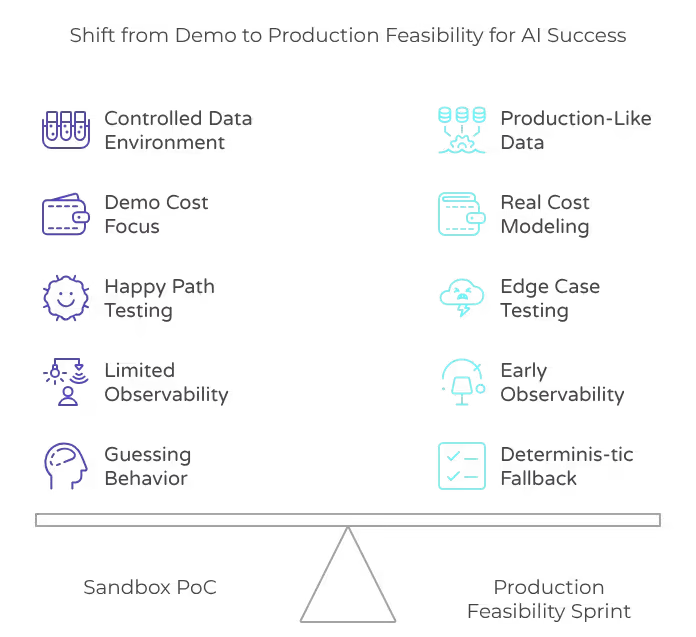
Instead of spending 90 days optimizing a controlled AI demonstration, enterprises should run a focused Production Feasibility Sprint before committing significant development resources. The goal is to determine whether an AI system can operate reliably, economically, and securely under realistic production conditions. Organizations can also use established frameworks such as NIST’s AI Risk Management Framework to structure AI risk management across the development and deployment lifecycle.
Gate AI Projects on Production Evidence, Not Demo Performance
A successful demo should never be the sole reason to move an AI project into development. Test the system with production-like data, live integrations, realistic workloads, and real-world failure scenarios before building the core application.
The question should change from “Does the model work?” to “Does the complete system work?”
Establish measurable go/no-go criteria covering latency, cost, reliability, security, observability, and fallback behavior. This prevents teams from investing months in an architecture that cannot meet production requirements.
The Five Metrics Every Enterprise AI PoC Should Prove
1. Production latency: Measure p50, p95, and p99 response times under realistic concurrency. A four-second demo response may become unacceptable in transactional workflows.
2. Unit economics: Calculate the real cost per transaction, including token usage, context-window expansion, model calls, retrieval, infrastructure, and cache misses. Production AI costs can vary significantly with workload and throughput, making realistic cost modeling essential.
3. Reliability: Test ambiguous inputs, incomplete data, prompt injections, API failures, timeouts, and other edge cases—not just happy paths.
4. Observability: Implement tracing and telemetry early. Tools such as Langfuse and Arize can help teams identify prompts, model calls, retrieval failures, latency bottlenecks, and problematic outputs.
5. Fallback behavior: Define what happens when the AI lacks confidence. Use deterministic rules, human escalation, alternative workflows, or structured error responses instead of allowing the model to guess.
Build the Architecture Around Failure, Not Perfection
Strong teams assume the AI models will hallucinate, users will provide ambiguous inputs, providers will change behavior, and data sources will fail. Design deterministic escape routes from day one.That mindset is healthier than chasing perfect output in a demo. It keeps risk management grounded in reality.
Architectures should include rollback procedures, retries, circuit breakers, and graceful degradation. In cloud computing environments, one provider issue or rate limit can affect the full workflow. If there is no backup path, a small outage becomes a major business problem.
This is one of the most practical ways to escape the PoC trap. Design for failure modes before launch, assign clear ownership, and make sure the system can fall back safely when confidence is low or a dependency is unavailable. That is how production trust is built.
Conclusion
Navigating the complexities of enterprise AI can feel overwhelming, especially when many initiatives fall into the costly 90-day PoC trap. It’s crucial for organizations to recognize that a successful transition from proof of concept to a production-ready solution hinges on real-world testing rather than polished demos. By addressing hidden costs, performance gaps, and organizational barriers, businesses can create a more robust framework for AI implementation. Embracing the Techwink fix—a structured approach to feasibility sprints—will help ensure projects are grounded in reality, paving the way for sustainable and impactful AI solutions. Remember, the goal should be to build an architecture designed for resilience against failure, allowing for continuous improvement and innovation in your enterprise AI journey.
Contents
Frequently Asked Questions
Most frequent questions and answers
The main issue is that an AI project proves possibility, not operational readiness. A proof of concept rarely tests live data, real business processes, cost, latency, or ownership. That creates a production gap, and many enterprise ai teams discover those blockers only after the demo is already approved.
Enterprises should tie each ai initiative to business value early, test in live environments, and measure production system latency, reliability, and unit economics. That approach supports ai adoption because leaders can judge ai success by operational evidence, not by a polished demo alone.
The most effective strategies are clear KPIs, strong data readiness, continuous evaluation, cost modeling, and fallback design from day one. When an ai project is built around measurable business outcomes and real operating constraints, value creation becomes easier and ai adoption has a much better chance to scale.