
Introduction
AI-first architecture sounds like the obvious next step in software development. If AI can reason, write, classify, and respond, why not let it sit at the center of everything? The problem is simple: great demos do not always create dependable products. When your system treats probabilistic behavior like stable business logic, user experience can break fast. To avoid that trap, you need to rethink where AI belongs, where certainty matters, and how architecture decisions shape product behavior over time.
Unpacking the “AI-First” Architecture TrapMany teams move toward AI-first architecture because generative AI feels transformative. It can classify requests, draft content, and support complex workflows that traditional software once struggled to handle.
Still, software development becomes risky when AI is asked to run everything. The same prompt can return different outputs, latency stretches into seconds, and core actions become harder to predict. That is where the trap appears. Before you redesign your stack, it helps to separate true AI-native products from systems that simply need smarter execution layers.
Defining AI-First Architecture in Software Development
In software development, AI-first architecture means the AI model is not just an add-on. It becomes central to the product’s value. Remove the model, and much of the app stops making sense. Data flow, prompts, streaming, and evaluation all shape the product experience.
That is very different from traditional software or simple AI augmentation. In many products, AI helps with interpretation, but the main workflows still depend on fixed automation. With agentic AI, the system may classify, extract, generate, and respond across multiple steps. That flexibility is powerful, but it also introduces non-determinism.
This is why deterministic APIs still matter. They preserve traditional software reliability inside modern AI-powered applications. APIs can validate data, enforce deterministic logic, and maintain a source of truth for actions that must behave the same way every time, even when AI handles the messy reasoning before execution.
Trends Driving AI-First Approaches in U.S. Organizations
Across U.S. organizations, interest in machine learning and large language models keeps rising because the value feels immediate. Teams see generative AI summarizing documents, classifying requests, and improving chat experiences, so they push for faster adoption. In many cases, leaders want proof of concept work to become real product architecture.
A few patterns are driving that shift:
- Products now stream responses in real time, making AI feel like the core interface rather than a side feature.
- Teams increasingly build prompt pipelines, routing and chaining model calls instead of using a single model.
- AI is moving into business workflows where speed and interpretation matter.
The common pitfalls show up when excitement outruns design discipline. Companies often underestimate latency, ignore output validation, rely too heavily on framework abstraction, and discover too late that retrofitting AI-native architecture into older systems can trigger a painful rewrite.
When “AI-First” Becomes a Pitfall
The trouble starts when teams treat AI as both brain and backbone. That can work in a demo, but production is less forgiving. If the system depends fully on probabilistic outputs, your product inherits all the weaknesses of the model. Model failures stop being edge cases and become business risks.
A few dangers appear quickly:
- Output quality can swing between useful and unusable, even with similar prompts.
- Prompt injection can distort workflows if there are no strong controls around what the system executes.
- Latency, rate limits, and outages can interrupt critical features.
Without a deterministic API backbone, product design loses consistency. There is no stable layer to validate inputs, enforce policy, or trigger safe fallback behavior. That means failures can ripple into customer-facing actions, damaging trust and making your architecture harder to test, audit, and improve.
What Makes a Reliable System Backbone?
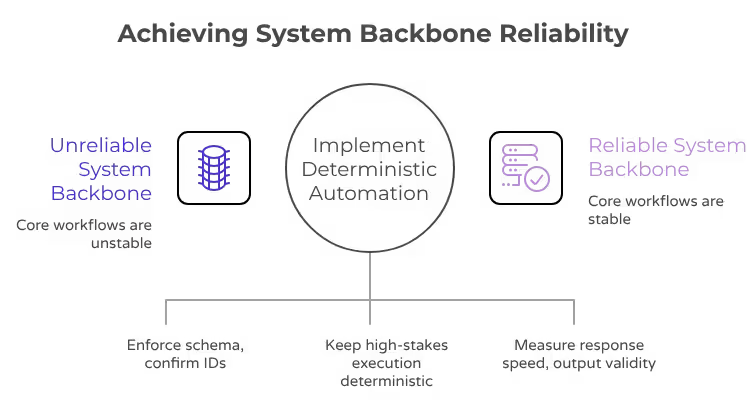
Reliable products need more than smart responses. They need a stable backbone that keeps core workflows moving the right way, every time. That is where deterministic automation earns its place.
When AI interprets messy input, something still has to control execution, data movement, and system-of-record updates. Reliability comes from that predictable layer, not from hopeful prompting alone. If you want a product that survives real usage, it helps to understand how traditional APIs created trust long before AI entered the picture.
The Traditional Role of Deterministic APIs
Traditionally, APIs exist to move data and trigger actions in a predictable way. If the same request hits the same endpoint, the expected result should follow. That consistency gives systems a dependable source of truth. It also makes automation easier to test, debug, and scale.
In AI-native or AI-first systems, that role does not disappear. It becomes more important. AI can interpret language, classify intent, or summarize content, but deterministic logic should still decide what happens next. Once a condition is met, the execution layer must remain stable.
Maintaining deterministic APIs matters because they keep the product grounded. They enforce schema rules, confirm IDs exist, update records correctly, and connect apps without guessing. When AI output varies, the API layer protects the rest of the system from drift, malformed responses, and accidental actions that could disrupt core workflows.
Why Predictability Matters for Core Features
Core features need predictability because users depend on them without thinking about the plumbing. If a support route, document update, or status change behaves differently from one request to the next, reliability drops fast. AI-first architecture can blur that line when the same input produces different outputs.
That affects products in clear ways:
- Traditional unit tests become less useful because exact outputs may change across runs.
- Critical features inherit model variability, which makes failures harder to reproduce.
- Provider updates can shift behavior overnight, even when your own code does not change.
Predictability does not mean avoiding AI. It means reserving AI for interpretation and keeping high-stakes execution deterministic. When you separate those responsibilities, core features stay stable, users see fewer surprises, and your team can improve quality without constantly chasing unexplained production behavior.
Reliability Benchmarks in Modern Applications
Modern applications need reliability benchmarks that reflect AI realities, not just traditional uptime thinking. You still care about errors and latency, but you also need quality scores, schema compliance, and evaluation pass rates. Without those metrics, weak output can quietly spread through your workflows.
A practical audit should track the system at several levels:
|
Benchmark Area
|
What to Measure
|
Why It Matters
|
|---|---|---|
|
Response speed
|
Latency per pipeline step
|
Finds slow stages before user experience degrades
|
|
Output validity
|
Schema and format validation pass rate
|
Catches malformed responses early
|
|
Quality control
|
Eval scores over time
|
Reveals prompt drift or model degradation
|
|
Cost stability
|
Token usage and cost per request
|
Prevents unsustainable scaling
|
|
Provider health
|
Error rates by model and provider
|
Supports routing and fallback decisions
|
If you overlook deterministic reliability, long-term success gets shaky. Products become harder to audit, failures spread across systems, and quality declines may go unnoticed until users lose confidence or teams face an expensive rewrite.
AI-Native vs. Deterministic Architecture: Understanding the Divide
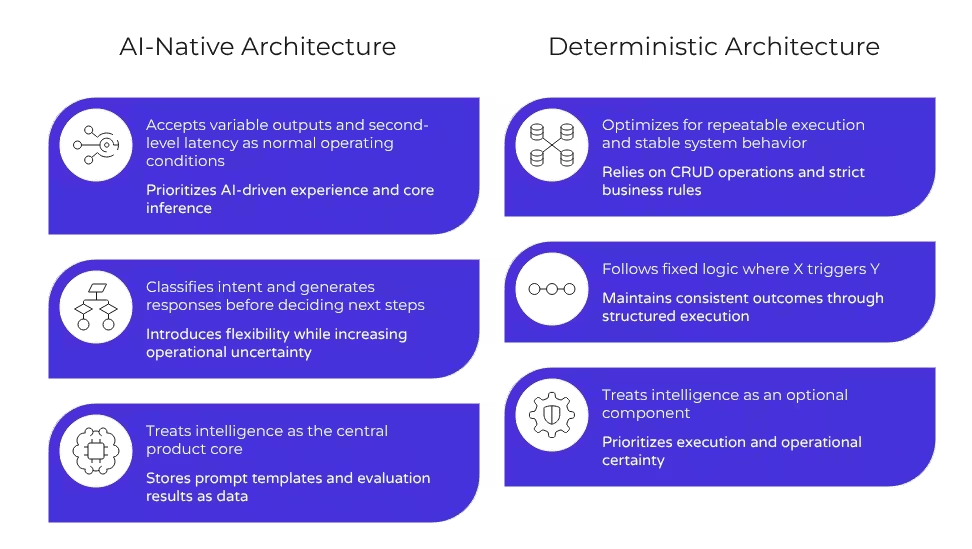
There is a real divide between AI-native architecture and deterministic automation. In one model, AI is the product. In the other, AI supports a workflow that still depends on structured execution.
That distinction matters more than many teams expect. If you misread your product’s value proposition, you may overbuild with LLMs or underuse them where they could help most. The next sections make that divide clearer by looking at backbone design, workflow handling, and practical use cases.
System Backbone Design: AI-Driven vs. Deterministic
AI-native backbone design starts from a different assumption: the AI system drives the experience. Prompts, streaming, evaluation, and inference are part of the product core. In traditional architectures, the backbone is usually deterministic logic tied to CRUD operations, app connections, and strict business rules.
That creates different design priorities:
- AI-driven backbones accept variable outputs and second-level latency as normal operating conditions.
- Deterministic backbones optimize for repeatable execution and stable system behavior.
- AI-native products often store prompt templates and evaluation results as central product data.
So how do they differ? Traditional systems treat intelligence as optional and execution as primary. AI-native systems invert that. Still, even an AI-driven product benefits from a deterministic backbone for validation, routing, and controlled actions. The strongest designs do not confuse creative reasoning with operational certainty.
Key Differences in Workflow Handling
Workflow handling changes dramatically once AI enters the loop. In traditional automation, if X happens, Y follows. In AI-centered workflows, the system may first classify intent, extract structured data, or generate a response before deciding what to do next. That adds flexibility, but it also increases uncertainty.
A balanced hybrid approach solves that tension. Let AI handle the ambiguous parts of workflows, such as interpretation, summarization, or judgment. Then pass the structured signal into deterministic automation. That execution layer updates records, routes requests, triggers downstream steps, and keeps outcomes consistent.
This balance is practical, not theoretical. It means AI can reason where fixed rules fall short, while a deterministic API layer preserves order. Product development becomes easier to monitor and improve because you know exactly which part of the stack is allowed to vary and which part must remain steady.
Real-world Case Studies: AI-Native and Deterministic Approaches
Real-world use cases show that architecture should follow product value, not hype. Some products are truly AI-native. Remove the model, and there is no meaningful MVP left. Others use AI as an augmentation layer that improves existing workflows without replacing the execution backbone.
A few examples make this clear:
- Tools like Cursor, Jasper, Harvey, and Perplexity are AI-native because the model is the product.
- Content, support, and sales workflows often use AI for interpretation, then rely on deterministic routing and follow-up.
- A polished demo may look autonomous, but production still needs stable controls.
Developers should prioritize deterministic APIs whenever the product must update records, enforce rules, route actions, or interact with systems of record. Even in an AI-first product, those moments require dependable behavior, not open-ended generation.
The Risks of Relying Solely on AI-First Architecture
It is easy to focus on AI’s upside and miss the structural risks. A product that leans only on model behavior can look impressive early on, then become fragile under real demand.
The biggest problems are rarely dramatic at first. Data drift, model staleness, variable quality, and weak controls often creep in quietly. Over time, those issues damage trust, raise costs, and make operations harder to manage. That is why the next risks deserve direct attention before they spread through your architecture.
Impact on Product Reliability and User Trust
When AI-first choices affect core features, reliability becomes uneven. A user may ask for the same thing twice and get two different outcomes. For brainstorming, that may be fine. For account actions, support handling, or factual responses, it hurts user experience.
Trust is built through consistency. If latency spikes, a model hallucinates, or a response arrives malformed, users stop seeing the product as dependable. They may not care whether the issue came from the LLM, the prompt pipeline, or a weak fallback. They just feel uncertainty.
That is the real impact on core features. Predictability drops, debugging gets harder, and confidence erodes. A deterministic execution layer helps restore trust by ensuring that once intent is understood, the next step follows stable rules rather than shifting model behavior.
Pitfalls: Data Drift, Model Staleness, and Inconsistent Output
Some of the most damaging failures are gradual. Data drift changes the quality of inputs over time. Model staleness appears when behavior no longer matches current needs. Inconsistent output shows up when the same prompt starts producing different structures, tone, or factual grounding. Without strong validation, these issues slip into production.
Watch for recurring problems such as:
- AI outputs that no longer fit your expected schema or business rules
- Provider updates that shift model behavior without warning
- Quality decline that spreads because no deterministic checkpoint blocks bad responses
A deterministic API backbone reduces these risks by checking structure, verifying fields, and stopping unsafe actions. On its own, AI can interpret messy data, but it should not be trusted to govern downstream execution without a controlled layer that catches drift before users do.
Regulatory and Compliance Challenges
In regulated settings, loose architecture choices create bigger problems. If your application prioritizes AI over deterministic processes, you may struggle to explain how decisions were made, why a response appeared, or whether output matched approved rules. That weakens both audit readiness and internal governance.
The challenge grows in areas like healthcare or other high-stakes domains:
- Teams need traceable workflows, not just plausible responses
- Unsupported claims can create serious downstream risk
- Human review often becomes necessary for ambiguous or sensitive cases
Compliance depends on clarity. You need logs, validation, review queues, and visible decision paths. Deterministic layers make that possible because they preserve explainable execution even when AI supports interpretation. Without them, accountability gets blurred, and that makes architecture much harder to defend during audits or operational reviews.
The Enduring Value of Deterministic APIs
Deterministic APIs still matter because products are judged by outcomes, not by how advanced the underlying model sounds. Reliability remains a basic requirement.That is especially true when modern AI has to live alongside legacy systems, existing workflows, and operational expectations. APIs give teams a dependable way to connect, validate, and execute without reinventing the whole stack around probabilistic behavior. To see why they keep their value, it helps to look at predictability, reliability, and integration together.
Safeguarding Predictability in Dynamic Environments
Dynamic environments change constantly. Inputs are messy, users are unpredictable, and upstream services may shift. In those conditions, predictability becomes even more valuable. Developers should prioritize deterministic APIs because they create stable boundaries around workflows that cannot afford surprise behavior.
This matters when AI is layered into products that already depend on legacy systems or established business processes. AI may classify a message, summarize a request, or identify urgency, but workflows still need to route correctly, update the right records, and trigger the right next step. Those actions should not vary.
Deterministic APIs protect that consistency. They give you a controlled execution layer that stays reliable even when the interpretation step is probabilistic. That separation keeps dynamic products usable, supports better testing, and prevents small model variations from turning into operational instability.
APIs as the Backbone for Traditional Reliability
An API backbone supports traditional reliability by making sure actions remain structured, repeatable, and observable. In modern AI-powered applications, that means AI can reason about input while automation handles execution with clear rules and expected outcomes.
Think about what the backbone controls. It confirms whether data exists, enforces schemas, routes tasks, updates systems, and triggers follow-up actions. Those jobs do not need creativity. They need accuracy. When AI output is passed through a deterministic API, you reduce the chance that a polished but flawed response can change records or launch the wrong workflow.
This is the bridge between old and new. AI increases flexibility at the front of the process, while the API layer preserves reliability at the back. That structure lets teams adopt intelligent features without abandoning the operational discipline that traditional software has always required.
Supporting Seamless Integration with Legacy Systems
Many companies do not start with a blank slate. They have legacy systems, existing integrations, and workflows that already run the business. Shifting toward AI-first architecture becomes difficult when those systems expect structured inputs, predictable timing, and fixed process handoffs.
Common integration challenges include:
- Older systems cannot easily accept variable AI output without translation or validation
- Teams face painful rewrites when they try to force AI-native patterns into traditional stacks
- Debugging grows harder when abstraction layers hide where failures happen
Deterministic APIs ease this transition. They act as a stable interface between AI interpretation and older infrastructure. Instead of replacing every operational dependency, you let AI enrich inputs while deterministic workflows preserve compatibility. That makes modernization more practical and lowers the risk of breaking the systems your organization still depends on.
Balancing AI Intelligence with Deterministic APIs
The smartest architecture choice is rarely all-AI or all-rules. Most strong systems use a hybrid approach that gives AI room to reason while keeping the API layer in charge of dependable execution.That balance is especially important in agentic workflows, where multiple steps, tools, and decisions interact. If you place the boundary well, your product can feel intelligent without becoming unstable. The next sections show practical ways to layer both sides together so your system stays useful under real production pressure.
Layering Strategies: AI and Deterministic Processes
A good layering strategy starts with one simple rule: AI interprets, deterministic automation executes. That keeps product development clear. The model handles ambiguity, while the API layer enforces guardrails and predictable outcomes. You do not ask the same component to brainstorm and govern at once.
A practical structure often looks like this:
- Trigger enters the system through a bounded workflow step
- AI classifies, extracts, summarizes, or scores the input
- API rules validate the result and launch the next deterministic action
This approach works because each layer has a job it is suited for. AI adds flexibility where rigid rules fail. Deterministic processes add control where variation is dangerous. Together, they form a system that is easier to test, monitor, and scale than one that treats every step as an open-ended model decision.
Hybrid Architectural Models for Robust Products
Robust products usually emerge from a hybrid approach, not from architectural purity. Even when a product feels deeply AI-native, the strongest systems still separate interpretation from execution. That design keeps the experience flexible without allowing core features to become unstable.
An AI-first approach can hurt reliability when it pushes probabilistic behavior into account updates, routing decisions, or system-of-record changes. Those steps need deterministic control. AI can still contribute by extracting intent, generating drafts, or supporting agentic workflows, but it should hand off to a stable execution layer before anything critical happens.
This model is practical because it respects both realities. AI is powerful at understanding complexity. Deterministic architecture is powerful at delivering repeatable outcomes. When you combine them well, you build robust products that feel intelligent to users and manageable to the teams responsible for keeping them reliable.
Workflow Examples: AI Augmentation, API Control
Many strong systems already follow a useful pattern: AI augmentation up front, API control at the end. This is ideal when inputs are unstructured but outcomes must stay consistent. The workflow benefits from interpretation without letting variable output directly control business actions.
Developers should prioritize deterministic APIs in scenarios like:
- Routing support tickets after AI classifies urgency
- Publishing content after AI turns rough input into a structured draft
- Triggering sales follow-ups after AI identifies intent from inbound messages
In each case, the workflow becomes smarter because AI reads ambiguity well. Yet the API still decides what gets updated, routed, shared, or escalated. That distinction matters. It gives you dependable execution while still taking advantage of AI where it adds the most value.
Architectural Patterns for Reliable AI-First Systems
Reliable AI-first systems do not happen by accident. They depend on patterns that bring determinism, auditability, and output quality into every important step.This becomes even more important in agentic workflows, where the system may chain tasks, route requests, and make several decisions before anything reaches the user. The right architecture patterns reduce fragility without stripping away useful intelligence. Three patterns stand out: deterministic API support, routing and fallbacks, and consistent evaluation loops.
Agentic Workflows Enhanced by Deterministic APIs
Agentic workflows can handle multi-step tasks like classification, extraction, drafting, and review. That sounds powerful, and it is. But when companies shift from traditional architecture, they often discover that agents alone are not enough. The workflow still needs clear boundaries, expected outputs, and stable decision points.
This is where deterministic logic strengthens the design. Instead of letting the agent freely control every downstream action, you constrain key transitions. The agent can reason, recommend, or prepare data, while APIs validate structure and trigger approved next steps. That prevents agentic systems from turning into opaque automation.
The challenge for teams is cultural as much as technical. Traditional engineers expect repeatability. AI introduces variation. Deterministic APIs bridge that gap by giving workflows a dependable execution spine, which makes AI-driven systems easier to trust, inspect, and maintain in production.
Routing, Chaining, and Fallback API Patterns
Reliable AI pipelines rarely depend on one prompt and one model. They use routing, chaining, and fallback patterns to improve quality and control cost. This is one of the clearest ways to balance AI-driven intelligence with deterministic APIs in product development.
Key patterns include:
- Sequential chaining, where one step classifies intent and another generates the response
- Routing, where simple tasks go to faster models and complex tasks go to stronger ones
- Fallback logic, where timeouts or poor outputs trigger retries, alternate providers, or cached responses
These patterns matter because AI remains probabilistic and provider-dependent. APIs add structure around that uncertainty. They coordinate which model gets called, when to retry, when to fail over, and what safe response to return. That gives your product flexibility without leaving reliability to chance.
Evaluation Loops for Consistent Output
One major risk of pure AI-first design is trusting raw output too quickly. Evaluation loops solve that by adding automated quality gates before or around delivery. They help protect users from fabricated details, malformed structure, and unsupported claims while giving teams a stronger audit trail.
Useful evaluation steps include:
- Structural checks for JSON, ranges, and required fields
- Fact or retrieval validation against source data
- Quality review through a judge model or human reviewer when confidence is low
These feedback loops turn vague trust into measurable control. They also create useful logs for later improvement. Over time, evaluation data becomes a valuable asset for prompt refinement, failure analysis, and governance. Without this layer, inconsistent output can quietly undermine the product and make quality issues far harder to catch.
Common Challenges When Prioritizing AI Over Determinism
Prioritizing AI over determinism creates a very specific kind of instability. The product may look smart on the surface, yet become difficult to control under real-world conditions.
Prompt injection, model failures, workflow confusion, and latency all become bigger issues when no stable execution layer limits the damage. These are not abstract concerns. They affect what users see, what teams can debug, and how expensive the system becomes to operate. Let’s look at the most common pressure points.
Model Failures: Handling Unexpected Output
Model failures are unavoidable. A response may time out, break schema, contain hallucination, or simply return different outputs for the same request. One common pitfall during the shift to AI-first design is assuming the model will usually behave well enough. In production, that assumption fails quickly.
Validation is the first defense. If the output should be JSON, parse it. If it references an ID, verify it. If it includes factual claims, compare them against source material. These checks catch many failures before they become user-facing problems or trigger bad downstream actions.
Handling unexpected output also requires degradation planning. Retry with a simpler prompt, switch providers, serve a cached response, or route the case for review. Teams that plan for failure early build calmer systems. Teams that do not often end up reacting during outages instead of controlling them.
Scaling Without Compromising API Reliability
Scaling AI products is not only about throughput. It is also about preserving API reliability while token usage, latency, and provider limits grow. AI-native architectures differ from traditional ones because inference becomes a major cost center, quality can shift with traffic, and bottlenecks may appear inside prompt pipelines rather than standard application code.
Helpful scaling practices include:
- Semantic caching to reduce repeat inference on similar requests
- Model routing so cheaper models handle simple tasks
- Token budgets that cap runaway usage per request or user
Observability is what makes these controls work. You need to see latency per step, cost by workload, and error rates by provider. Traditional systems scale around stable functions. AI-heavy systems scale around variable model behavior. That is why a reliable API layer and strong monitoring must grow together.
Monitoring and Observability in AI-First Architectures
If your architecture prioritizes AI over deterministic processes, monitoring becomes more complex right away. Standard APM is not enough. You also need an observability stack that tracks prompt performance, token usage, quality scores, provider errors, and cost per request. Without that, failure patterns stay hidden.
Monitoring should focus on metrics that explain both technical and product health. Which pipeline step causes latency? Is output quality slipping after a provider update? Are costs rising because prompts are bloated? These signals matter just as much as uptime. In AI systems, a response can be fast and still be bad.
The challenge is that variability comes from many sources at once: prompts, models, routing, retrieval, concurrency, and evaluation behavior. Good observability gives you clarity across that pipeline, so you can diagnose issues before they reach users and tune the system with confidence.
Designing Future-Proof API Strategies
Future-proof API strategies start with one mindset shift: do not confuse a promising proof of concept with a durable production design. What works in a quick prototype may create cost, quality, and control issues later.
Strong API integration plans give you room to adopt new models and future trends without rebuilding your entire product each time the market shifts. That means thinking beyond today’s demo and designing for long-term flexibility, stable execution, and measurable improvement from the start.
Detailing Best Practices for API Integration
Good API integration starts with guardrails. A proof of concept can get away with direct model calls and loose logic, but production needs clearer separation. Balance AI-driven intelligence by isolating interpretation steps and connecting them to deterministic execution through validated interfaces.
A few best practices stand out:
- Define bounded triggers so AI only operates within a clear workflow context
- Validate outputs before they reach downstream systems
- Prototype with frameworks if needed, then replace abstraction-heavy parts as your needs become clearer
These practices protect flexibility without locking you into fragile architecture. AI still helps where nuance matters, but the API layer remains responsible for approved actions. That structure makes debugging easier, supports gradual adoption, and gives your team a more reliable path from early experiment to stable product behavior.
Future Trends: On-Device AI, Specialized Hardware
Future trends like on-device AI and specialized hardware may change where inference happens, but they do not remove the need for deterministic reliability. Even if models become faster, cheaper, or more personalized, products will still need a stable layer that validates output and governs actions.
That remains true because:
- Personalization increases variability, which raises the need for controlled execution
- New hardware may improve speed, but it does not guarantee correct business behavior
- Distributed AI usage can make observability and consistency even more important
So the role of deterministic APIs stays the same. They preserve traditional software reliability inside changing AI environments. Whether a model runs in the cloud, on-device, or across specialized hardware, APIs still anchor data integrity, enforce workflow rules, and provide the predictable handoffs that production systems depend on.
Ensuring Long-Term Success for AI-Powered Products
Long-term success depends on more than launch quality. AI-powered products need systems that improve through feedback loops, stay explainable under audit, and hold up as providers, prompts, and workloads change. If you overlook deterministic reliability, those goals become much harder to reach.A fragile execution layer creates hidden costs. Teams spend more time chasing inconsistent behavior, retraining reviewers, and reacting to provider changes. Users feel the instability first, but the organization pays for it later through rework, trust loss, and stalled product progress. What looked fast at launch becomes expensive to maintain.
A steadier model works better. Capture evaluation results, log human corrections, track quality over time, and keep core actions deterministic. That creates a product that can learn and adapt without losing control. Over time, that discipline becomes a meaningful competitive advantage.
Conclusion
In conclusion, navigating the complexities of AI-first architecture requires a careful balance between innovative AI capabilities and the reliability provided by deterministic APIs. By understanding the risks and pitfalls associated with an “AI-First” approach, organizations can develop hybrid models that leverage the strengths of both systems. This ensures not only enhanced user trust and product reliability but also seamless integration with existing infrastructure. As you rethink your API strategy, remember that a thoughtful blend of AI intelligence and traditional API frameworks is key to future-proofing your applications. For more personalized insights and strategies tailored to your organization, feel free to reach out for a consultation!