Introduction
The modern enterprise software landscape is buzzing with a big question: should you subscribe to a SaaS AI solution or build your own custom AI? As AI shifts from a nice-to-have feature to a core business driver, companies are under pressure to make the right choice. This decision can shape your costs, speed, and long-term competitive power. This article will help you navigate this dilemma and figure out the best path for your organization.
The Decision Dilemma: SaaS vs Custom Internal AI Tools
Deciding between buying and building an AI tool is more critical than ever. On one hand, SaaS platforms offer speed and simplicity. On the other, a custom AI solution promises a perfect fit for your unique needs.
Making the right choice isn’t just about technology; it’s a strategic decision that impacts your budget, operations, and future growth. Let’s break down what each option entails so you can determine the best approach for your business.
Defining SaaS Subscriptions and Custom Internal AI Tools
SaaS (Software as a Service) subscriptions are ready-made SaaS products you pay to use, often on a per-user basis. Think of AI-powered CRM platforms, automated customer support chatbots, or intelligent analytics dashboards. These tools are designed for a broad audience and offer standardized features that work out of the box.
In contrast, custom AI tools are built from the ground up specifically for your organization. This custom development involves creating an AI solution tailored to your proprietary data, internal processes, and strategic goals. These internal tools can range from custom machine learning models to unique workflow automation engines designed to solve your specific business problems.
The key factors to consider when deciding between them include cost, how much customization you need, data privacy concerns, and whether you’re seeking a unique competitive edge. The choice you make will define how AI integrates into your business and the long-term value you get from it.
Why Companies Are Rethinking Their SaaS Stack
Many organizations are taking a hard look at their existing SaaS stack and wondering if it’s truly delivering. While off-the-shelf tools are convenient, they often fall short of meeting specific, complex business needs. This gap is prompting a shift toward more tailored solutions.
Companies are moving away from generic tools because they are seeking better alignment with their unique operations. The main drivers behind this reevaluation include:
-
The desire to optimize business value and see a clearer return on investment.
-
The need to gain a competitive edge that one-size-fits-all software can’t provide.
-
A push for more effective workflow automation that fits perfectly with internal processes.
Ultimately, businesses realize that relying solely on standard SaaS products might mean missing out on opportunities for deeper transformation and differentiation in the marketplace.
What Does “Build vs. Buy” Mean in an AI Context?
In the AI context, the “build vs buy” debate takes on new dimensions. It’s not just about owning code; it’s about owning the logic, data, and intelligence that drive your business forward. “Buying” means using a pre-packaged AI feature within a SaaS product, while “building” refers to creating custom software using software development resources.
The decision has distinct trade-offs:
-
Buy (SaaS): Faster to deploy, lower upfront cost, but less flexible and creates vendor dependency.
-
Build (Custom): Higher initial investment and slower to market, but offers complete control, customization, and a potential long-term competitive advantage.
For AI projects, this decision is particularly important because the AI’s performance is often tied to your unique data and processes. A generic model might not be as effective as one trained on your specific information, making the build-versus-buy question a strategic one.
Key Factors Driving SaaS Replacement Decisions
Several key factors are pushing organizations to replace their SaaS tools with custom AI solutions. The primary driver is the pursuit of specific business outcomes that generic software just can’t deliver. Companies want AI that provides tailored decision support and integrates seamlessly with their core operations.
This shift involves collaboration between different stakeholders. While SaaS vendors promise simplicity, an internal AI team can build solutions that offer a deeper strategic advantage. Understanding these driving factors is the first step in making an informed decision about building your own tools.
Business Process Alignment and Differentiation
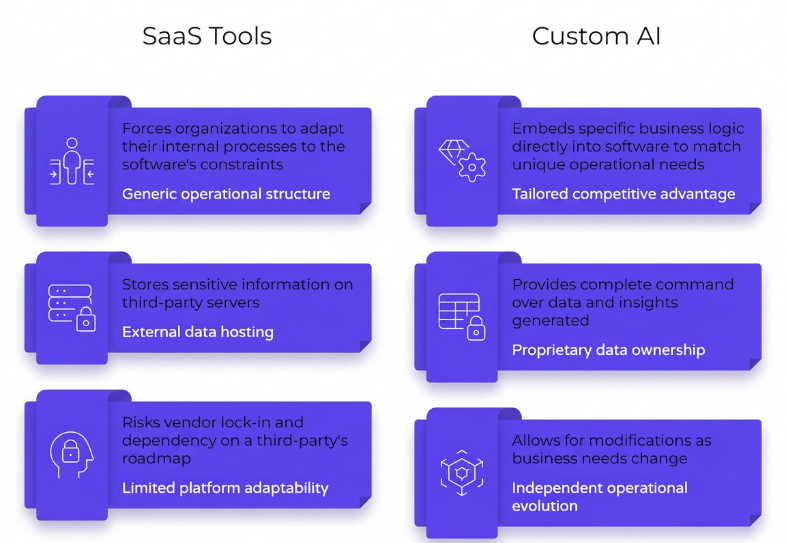
When a company’s internal business process is a source of its competitive advantage, relying on a generic SaaS tool can be limiting. The need for differentiation is a powerful motivator for building custom AI. These solutions can be designed to perfectly match your unique operational needs.
By developing custom workflow engines, you can embed your specific business logic directly into your software. This ensures that the technology supports your process, not the other way around. For example, a logistics company might build a custom routing algorithm that generic software could never replicate, giving them a significant edge.
Ultimately, specific business needs like proprietary workflows, unique customer engagement models, or specialized data analysis prompt the switch to custom AI. It’s about creating a tool that does exactly what you need it to do, enabling you to operate more efficiently and stand out from the competition.
Data Ownership, Privacy, and Compliance Concerns
Concerns over data ownership, privacy, and compliance are major reasons why companies opt for custom AI. When you use a SaaS platform, your sensitive information is stored on a third-party server, raising questions about control and security.
Building your own AI tool gives you complete command over your data. This is especially critical for industries with strict regulatory requirements or those handling proprietary data. Key considerations include:
-
Data Ownership: With custom AI, you own your data and the insights it generates.
-
Access Control: You can implement granular access control measures tailored to your organization’s policies.
-
Compliance: Meeting industry-specific regulations like HIPAA or GDPR is easier when you control the entire data environment.
These privacy and compliance factors are often the tipping point for businesses deciding between SaaS and custom solutions, as the risks associated with data breaches or non-compliance can be enormous.
Vendor Lock-In and Flexibility Requirements
One of the biggest risks of relying on SaaS vendors is vendor lock-in. Once your data and processes are deeply integrated into a platform, it can be incredibly difficult and costly to switch. This lack of flexibility can stifle growth and innovation as your business evolves.
SaaS platforms can also limit your workflow automation capabilities, forcing you to adapt your processes to the software’s constraints. If a vendor decides to change features, raise prices, or even go out of business, your operations could be severely disrupted. The drawbacks of staying with a single vendor often become apparent when the business needs to scale or pivot.
Building custom AI tools is a way to regain control. It allows you to create solutions that are perfectly aligned with your workflows and can be modified as your needs change, freeing you from dependency on a third-party’s roadmap and business decisions.
Total Cost of Ownership: Comparing SaaS Subscription Costs to Custom AI Tool Development
When deciding between SaaS and custom AI, looking beyond the initial price tag is essential. A thorough cost analysis must consider the total cost of ownership (TCO), which includes all expenses over the software’s lifespan, from initial setup to ongoing maintenance. While SaaS costs seem predictable, they can hide long-term expenses.
Conversely, custom AI has a higher upfront investment but may offer better long-term value. Let’s compare the general cost structures:
|
Cost Factor
|
SaaS Subscriptions
|
Custom AI Tools
|
|---|---|---|
|
Initial Cost
|
Low (setup fees, first month)
|
High (development, infrastructure)
|
|
Ongoing Costs
|
Predictable (monthly/annual fees)
|
Variable (maintenance, updates, hosting)
|
|
Scaling Costs
|
Increases per user/feature
|
Primarily infrastructure costs
|
|
Hidden Costs
|
Integration, customization limits
|
Technical debt, talent retention
|
This comparison shows that a simple price check isn’t enough; you need to dig deeper into both direct and hidden costs.
Direct and Hidden Costs of SaaS
The appeal of SaaS often lies in its seemingly straightforward SaaS costs, typically presented as predictable subscription fees. However, the true price of an off-the-shelf tool is often much higher once you account for the various hidden costs that emerge over time.
These additional expenses can quickly add up, making your AI tool more expensive than you initially budgeted for. Some common hidden costs include:
High fees for implementation, data migration, and staff training.
Extra charges for integrating the SaaS tool with your other systems.
Price hikes for adding more users or accessing premium features.
Costs associated with customization limits that force you to create workarounds.
When the tool you’ve chosen doesn’t perfectly fit your needs, you end up paying for features you don’t use while still lacking the functionality you require. This mismatch can significantly inflate your overall spending and reduce the tool’s value.
Upfront Investments and Ongoing Maintenance for Custom AI Tools
Building a custom AI solution undeniably requires a higher upfront investment. This initial cost covers everything from architecting the system to the actual software development, testing, and deployment. You’ll need to budget for skilled AI development teams, project management, and the necessary infrastructure.
However, the costs don’t stop once the tool is launched. Ongoing maintenance is a critical responsibility that falls on your shoulders. This includes monitoring model performance, retraining algorithms with new data, fixing bugs, and ensuring the system remains secure and compliant. These tasks require a dedicated team and continuous investment.
Despite these costs, the long-term benefit is a tool that perfectly fits your needs and delivers a superior user experience. The control and alignment you gain can translate into significant operational efficiencies and a stronger competitive position over time.
Cost Implications: Scalability and Long-Term Savings
While the initial cost of building a custom AI solution is high, it can lead to significant long-term savings. A custom tool is designed for scalability, meaning it can grow with your business without the per-user price hikes common with SaaS. This improved operational efficiency can generate substantial returns over time.
Building an AI tool often saves money when your operations reach a certain scale or complexity. For instance, if you need to integrate your AI with multiple legacy systems, custom middleware development can be more cost-effective than trying to force a SaaS product to work. As your transaction volume or user count grows, the marginal cost of a custom application is often much lower than escalating SaaS fees.
Consider a logistics company that builds a custom dispatch system. The upfront investment is steep, but the resulting fuel savings, optimized routes, and ability to handle more deliveries without adding staff create a clear path to long-term profitability that a generic SaaS solution couldn’t match.
Risks and Challenges in Transitioning from SaaS to Custom Internal AI Solutions
Moving from a familiar SaaS product to a custom-built AI solution is not without its challenges. The transition risk is real and includes potential hurdles like accumulating technical debt, integrating with legacy systems, and the complexities of machine learning development.
Beyond the technical aspects, change management is a huge factor. You need to ensure your team is prepared to adopt the new tool and workflow. Successfully navigating these risks requires careful planning, a skilled team, and a clear understanding of the potential pitfalls ahead.
Technical Debt and Implementation Complexities
One of the biggest risks in custom software development is accumulating technical debt. This happens when teams take shortcuts to release features quickly, resulting in code that is difficult to maintain or update later. Over time, this can slow down innovation and increase costs, creating significant implementation complexity.
Your AI team must focus on writing clean, well-documented, and functional code from the start. Without disciplined development practices, what seems like a powerful custom tool can quickly become a tangled mess that no one wants to work on. The pressure to deliver can lead to choices that create long-term problems.
To mitigate this, it’s crucial to allocate time for refactoring code, conducting regular code reviews, and investing in solid architectural design. Acknowledging and managing technical debt as part of the development process is essential for the long-term health and success of your custom AI solution.
Security Considerations: Custom vs SaaS
When it comes to security, the custom vs. SaaS AI debate is nuanced. SaaS vendors often have large security teams and robust infrastructure, but you are still trusting a third party with your data. Custom tools put security responsibilities on you, but also give you complete control.
Whether a custom tool is more secure depends on your ability to implement and maintain strong security practices. Key factors to consider include:
Access Control: Custom solutions allow you to build fine-grained access control rules that perfectly match your internal security policies.
Proprietary Data: You can implement specific protections for your most sensitive proprietary data without relying on a vendor’s generic safeguards.
Regulatory Requirements: Custom builds make it easier to design systems that meet specific industry regulatory requirements from the ground up.
A common misconception is that SaaS is always more secure. While vendors invest heavily in security, a well-designed custom application can offer superior protection for your unique data and compliance needs, as you control every aspect of its security posture.
Potential Pitfalls: Data Migration, Shadow IT, and Change Management
Transitioning from SaaS to a custom AI tool is a complex process filled with potential pitfalls. Successful change management is crucial, as resistance from users accustomed to the old system can derail the entire project. The user experience of the new tool must be intuitive and efficient to encourage adoption.
Another major challenge is data migration. Moving data from one system to another is rarely straightforward and can lead to issues with data quality if not handled carefully. Furthermore, if the new tool doesn’t meet everyone’s needs, employees may resort to unauthorized apps, creating a shadow IT problem.
Key pitfalls to avoid include:
Poorly planned data migration leading to lost or corrupted data.
Ignoring the need for comprehensive change management and user training.
A subpar user experience that frustrates employees and lowers productivity.
The rise of shadow IT as a result of an inadequate custom solution.
Evaluating When to Build: Common Scenarios and Triggers
So, how do you know when it’s time to build your own AI tool? Certain scenarios and use cases are strong indicators that a custom solution is the right starting point. These triggers often emerge when off-the-shelf products can no longer support your growth or unique operational needs.
A deep business analysis is required to identify these moments. When you find that your core processes are being constrained by your current software, or that you have a unique opportunity for differentiation, it’s a clear sign that you should explore building.
Business Growth, Scale, and Specialized Workflows
Rapid business growth is a primary trigger for considering custom AI. As your company begins to scale, you may find that your existing SaaS tools are becoming prohibitively expensive or can no longer handle your increasing transaction volume and complexity.
Specialized workflows that are core to your business also push companies toward custom solutions. When your workflow automation needs are unique, trying to fit them into the rigid structure of generic software or standard ERP systems can be inefficient and frustrating. A custom solution can be built to accommodate these specific processes perfectly.
Here are some indicators that your business scale demands a switch to custom AI:
SaaS subscription costs are escalating uncontrollably as you add users.
Your current tools are slowing down under increased data loads.
You are spending more time creating workarounds than doing actual work.
Your workflows are unique and provide a competitive advantage.
Competitive Advantage Through Customization
The ultimate reason to build is to gain a competitive advantage. While SaaS tools put you on a level playing field with your competitors, customization allows you to create something unique that they cannot easily replicate. This is where true value creation happens.
By building your own AI, you can develop proprietary algorithms for things like predictive analytics. For example, a retail company could create a custom recommendation engine that understands its customers far better than a generic one, leading to a superior customer experience and increased sales. This level of tailoring directly impacts your bottom line.
Custom AI delivers this advantage by deeply embedding your unique business logic and data into the software itself. It transforms technology from a simple tool into a strategic asset that drives differentiation and helps you win in the market.
Industry Examples: Successful SaaS-to-AI Tool Transitions
Many companies across various industries have successfully moved from generic SaaS products to a custom AI tool. In sectors like real estate and financial services, where proprietary data and unique workflows are common, the benefits of building are particularly clear.
Here are a few examples of successful transitions:
A real estate firm replaced its standard CRM with a custom AI platform to analyze market trends and predict property values with greater accuracy, giving its agents a competitive edge.
A financial services company built its own fraud detection system, which used machine learning to identify suspicious transactions in real-time, significantly reducing losses compared to its previous SaaS solution.
These examples show that the investment in custom software development can pay off handsomely. The key takeaway for any team is that when a core business function is limited by off-the-shelf software, a custom solution can unlock new levels of performance and innovation.
Conclusion
In conclusion, the decision between maintaining SaaS subscriptions and developing custom internal AI tools is multifaceted and hinges on various factors, including cost, security, and alignment with business objectives. An effective evaluation of your company’s unique needs can lead you to a solution that not only supports your current operations but also paves the way for future growth and innovation. By weighing the risks and benefits associated with each option, you can make an informed choice that positions your organization for success in an ever-evolving digital landscape. If you’re ready to explore how custom solutions can transform your operations, consider reaching out for a free consultation to discuss your options further.