Introduction
The modern enterprise software landscape is buzzing with a big question: should you subscribe to a SaaS AI solution or build your own custom AI? As AI shifts from a nice-to-have feature to a core business driver, companies are under pressure to make the right choice. This decision can shape your costs, speed, and long-term competitive power. This article will help you navigate this dilemma and figure out the best path for your organization.
The Decision Dilemma: SaaS vs Custom Internal AI Tools
Deciding between buying and building an AI tool is more critical than ever. On one hand, SaaS platforms offer speed and simplicity. On the other, a custom AI solution promises a perfect fit for your unique needs.
Making the right choice isn’t just about technology; it’s a strategic decision that impacts your budget, operations, and future growth. Let’s break down what each option entails so you can determine the best approach for your business.
Defining SaaS Subscriptions and Custom Internal AI Tools
SaaS (Software as a Service) subscriptions are ready-made SaaS products you pay to use, often on a per-user basis. Think of AI-powered CRM platforms, automated customer support chatbots, or intelligent analytics dashboards. These tools are designed for a broad audience and offer standardized features that work out of the box.
In contrast, custom AI tools are built from the ground up specifically for your organization. This custom development involves creating an AI solution tailored to your proprietary data, internal processes, and strategic goals. These internal tools can range from custom machine learning models to unique workflow automation engines designed to solve your specific business problems.
The key factors to consider when deciding between them include cost, how much customization you need, data privacy concerns, and whether you’re seeking a unique competitive edge. The choice you make will define how AI integrates into your business and the long-term value you get from it.
Why Companies Are Rethinking Their SaaS Stack
Many organizations are taking a hard look at their existing SaaS stack and wondering if it’s truly delivering. While off-the-shelf tools are convenient, they often fall short of meeting specific, complex business needs. This gap is prompting a shift toward more tailored solutions.
Companies are moving away from generic tools because they are seeking better alignment with their unique operations. The main drivers behind this reevaluation include:
The desire to optimize business value and see a clearer return on investment.
The need to gain a competitive edge that one-size-fits-all software can’t provide.
A push for more effective workflow automation that fits perfectly with internal processes.
Ultimately, businesses realize that relying solely on standard SaaS products might mean missing out on opportunities for deeper transformation and differentiation in the marketplace.
What Does “Build vs. Buy” Mean in an AI Context?
In the AI context, the “build vs buy” debate takes on new dimensions. It’s not just about owning code; it’s about owning the logic, data, and intelligence that drive your business forward. “Buying” means using a pre-packaged AI feature within a SaaS product, while “building” refers to creating custom software using software development resources.
The decision has distinct trade-offs:
Buy (SaaS): Faster to deploy, lower upfront cost, but less flexible and creates vendor dependency.
Build (Custom): Higher initial investment and slower to market, but offers complete control, customization, and a potential long-term competitive advantage.
For AI projects, this decision is particularly important because the AI’s performance is often tied to your unique data and processes. A generic model might not be as effective as one trained on your specific information, making the build-versus-buy question a strategic one.
Key Factors Driving SaaS Replacement Decisions
Several key factors are pushing organizations to replace their SaaS tools with custom AI solutions. The primary driver is the pursuit of specific business outcomes that generic software just can’t deliver. Companies want AI that provides tailored decision support and integrates seamlessly with their core operations.
This shift involves collaboration between different stakeholders. While SaaS vendors promise simplicity, an internal AI team can build solutions that offer a deeper strategic advantage. Understanding these driving factors is the first step in making an informed decision about building your own tools.
Business Process Alignment and Differentiation
When a company’s internal business process is a source of its competitive advantage, relying on a generic SaaS tool can be limiting. The need for differentiation is a powerful motivator for building custom AI. These solutions can be designed to perfectly match your unique operational needs.
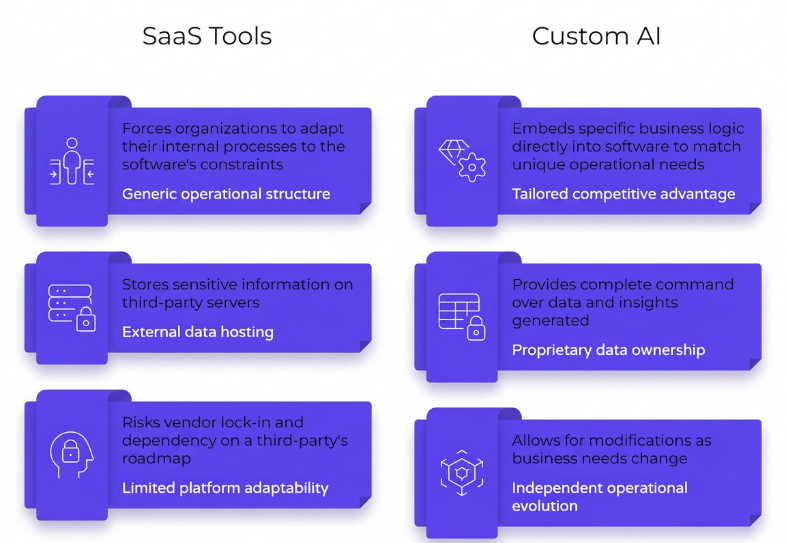
By developing custom workflow engines, you can embed your specific business logic directly into your software. This ensures that the technology supports your process, not the other way around. For example, a logistics company might build a custom routing algorithm that generic software could never replicate, giving them a significant edge.
Ultimately, specific business needs like proprietary workflows, unique customer engagement models, or specialized data analysis prompt the switch to custom AI. It’s about creating a tool that does exactly what you need it to do, enabling you to operate more efficiently and stand out from the competition.
Data Ownership, Privacy, and Compliance Concerns
Concerns over data ownership, privacy, and compliance are major reasons why companies opt for custom AI. When you use a SaaS platform, your sensitive information is stored on a third-party server, raising questions about control and security.
Building your own AI tool gives you complete command over your data. This is especially critical for industries with strict regulatory requirements or those handling proprietary data. Key considerations include:
Data Ownership: With custom AI, you own your data and the insights it generates.
Access Control: You can implement granular access control measures tailored to your organization’s policies.
Compliance: Meeting industry-specific regulations like HIPAA or GDPR is easier when you control the entire data environment.
These privacy and compliance factors are often the tipping point for businesses deciding between SaaS and custom solutions, as the risks associated with data breaches or non-compliance can be enormous.
Vendor Lock-In and Flexibility Requirements
One of the biggest risks of relying on SaaS vendors is vendor lock-in. Once your data and processes are deeply integrated into a platform, it can be incredibly difficult and costly to switch. This lack of flexibility can stifle growth and innovation as your business evolves.
SaaS platforms can also limit your workflow automation capabilities, forcing you to adapt your processes to the software’s constraints. If a vendor decides to change features, raise prices, or even go out of business, your operations could be severely disrupted. The drawbacks of staying with a single vendor often become apparent when the business needs to scale or pivot.
Building custom AI tools is a way to regain control. It allows you to create solutions that are perfectly aligned with your workflows and can be modified as your needs change, freeing you from dependency on a third-party’s roadmap and business decisions.
Total Cost of Ownership: Comparing SaaS Subscription Costs to Custom AI Tool Development
When deciding between SaaS and custom AI, looking beyond the initial price tag is essential. A thorough cost analysis must consider the total cost of ownership (TCO), which includes all expenses over the software’s lifespan, from initial setup to ongoing maintenance. While SaaS costs seem predictable, they can hide long-term expenses.
Conversely, custom AI has a higher upfront investment but may offer better long-term value. Let’s compare the general cost structures:
Cost Factor | SaaS Subscriptions | Custom AI Tools |
|---|---|---|
Initial Cost |
Low (setup fees, first month) |
High (development, infrastructure) |
Ongoing Costs |
Predictable (monthly/annual fees) |
Variable (maintenance, updates, hosting) |
Scaling Costs |
Increases per user/feature |
Primarily infrastructure costs |
Assessing Performance and Meeting Business Needs
Performance isn’t just about speed; it’s about how well the AI model helps you meet your business needs. Does it generate accurate content? Does it understand user intent correctly? The right performance level for your SaaS depends entirely on what your customers expect. For some applications, “good enough” is perfect, while for others, state-of-the-art accuracy is non-negotiable.
When assessing performance, you use the present tense: “This model builds strong arguments” or “He builds a successful business.” There are also common idioms, like “Rome wasn’t built in a day,” which means great things take time to create. Another is to “build castles in the air,” which means to make unrealistic plans. These phrases show how the concepts of “build” and “built” are ingrained in how we talk about creation and effort.
Ultimately, your goal is to find the sweet spot between performance and cost. A high-performing but expensive model might not be viable for a low-margin SaaS product.
Continuously test and measure the AI’s output against your key business metrics to ensure it delivers real value.
Managing Growth and Scaling AI SaaS Solutions
As your AI SaaS grows, your needs will change. A solution that works for 100 users might buckle under the pressure of 100,000. Scalability is about ensuring your AI infrastructure can handle increased demand without a drop in performance or a massive spike in costs. A properly built system is designed for growth from the start.
The choice between “build” and “built” doesn’t significantly affect the tone, but it does signal the status of a project. Using “build” (present tense) sounds active and forward-looking, while “built” (past tense) conveys completion and stability. For a scaling discussion, both are relevant. To manage growth effectively, you need to:
- Plan for increased load: Whether you’re using an API or a custom model, understand the breaking points.
- Monitor costs closely: Usage-based pricing can escalate quickly, so keep an eye on your spending.
- Have a flexible architecture: Design your SaaS so you can swap out or upgrade AI models as better options become available.
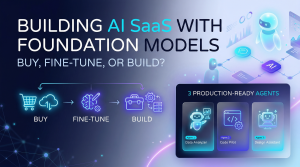
Your initial choice to buy, fine-tune, or build will heavily influence your scaling strategy. API-based solutions are often easy to scale (if you can afford it), while custom-built models give you more control over infrastructure and efficiency.
Conclusion
In conclusion, choosing the right approach for building AI SaaS with foundation models is crucial for your business success. Understanding when to buy, fine-tune, or build these models can help you leverage their capabilities effectively while balancing cost, performance, and scalability. Each option carries its own set of advantages and limitations, and it’s important to align your decision with your company’s specific needs and goals. By carefully evaluating these factors, you can create a robust AI solution that meets your users’ demands and drives growth. If you’re ready to explore your options further, don’t hesitate to reach out for a consultation!