Introduction
Welcome to the exciting world of artificial intelligence SaaS and modern product innovation! If you’re looking to create your own AI-powered application, you’ve likely encountered large language models (LLMs) and foundation AI models.
These models power cutting-edge tools from companies like OpenAI and Google AI, enabling developers to build intelligent applications faster than ever.
But the key question remains: should you buy AI APIs, fine-tune models, or build custom AI systems from scratch?
If you’re exploring broader strategies, this guide aligns well with insights shared on AI SaaS strategy insights to help you make informed decisions.
Understanding Foundation Models for AI SaaS
At their core, foundation models in AI are large-scale systems trained on massive datasets. Platforms like AWS Machine Learning and IBM Watson provide access to such models. Think of them as a highly knowledgeable, general-purpose starting point for a wide range of tasks. For AI SaaS, they provide the underlying intelligence that powers features like content generation, data analysis, and customer support automation.
By using these models, you can develop sophisticated applications without starting your machine learning journey from zero. The key is to figure out how to adapt this general intelligence to your specific business problem. Let’s explore the different types of models available and how they can be used.
Types of Foundation Models and Their Key Characteristics
Foundation models come in various forms, each with unique characteristics. Some are specialized for language, while others excel at generating images or code. Understanding the difference in meaning between “build” and “built” is helpful here; “build” is the present tense action of creating, while “built” is the past tense and past participle, referring to something already constructed. For instance, a company might decide to build a new model, and once completed, it is a custom-built solution.
Their key characteristics often depend on the dataset they were trained on and their intended purpose. When choosing a model, consider the following:
- Model Type: Is it a language model, an image model, or a multi-modal one?
- Size: Larger models are often more capable but also more expensive to run.
- Training Data: The diversity and quality of the training dataset determine the model’s knowledge and potential biases.
- Specialization: Some models are pre-trained for specific industries like healthcare or finance.
The word “build” can also be used as a noun, referring to the physical structure or proportions of something, like a “car’s impressive build.” In contrast, “built” is only used as a verb, in its past or participle form. Organizations often rely on frameworks from Meta AI and Microsoft Azure AI to deploy scalable solutions.
How Foundation Models Power AI SaaS Solutions
Foundation models are the backbone of modern AI SaaS solutions. Through careful AI engineering, you can integrate these models to perform complex tasks that provide value to your users. For example, a marketing SaaS tool could use a foundation model to generate ad copy, while a customer service platform might use one to power an intelligent chatbot. Companies adopting these approaches often follow best practices outlined by Google Cloud AI.
So, when should you use “build” versus “built” in a sentence? Use “build” when talking about a current or future action of construction. For instance, “We plan to build new features into our SaaS platform.” Use “built” when referring to a completed action in the past. For example, “Our core platform was built on a powerful foundation model.”
The magic happens when you connect a foundation model’s general capabilities to your specific application needs. A product that is well-built can offer features like sentiment analysis, document summarization, or code generation, all powered by the same underlying model. The tense you choose—present or past—simply clarifies the status of the development work.
Buy, Fine-Tune, or Build: Deciding Your Approach
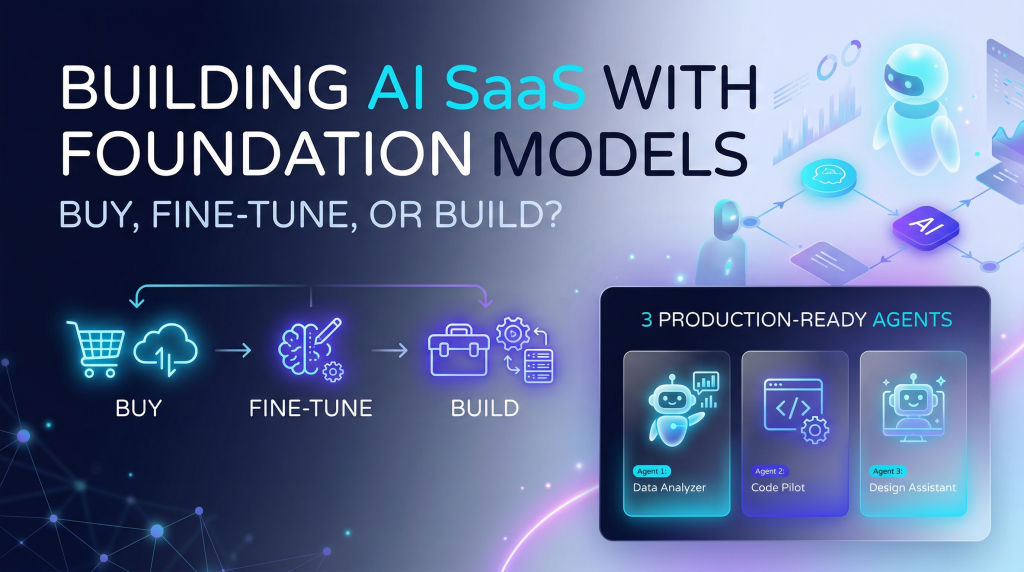
Now for the central question: what is the right strategy for your AI SaaS product? Your decision to buy, fine-tune, or build will impact your budget, timeline, and the final product’s capabilities. Each path has distinct advantages and trade-offs that you need to weigh carefully.
The choice isn’t always straightforward. Buying a model is fast, fine-tuning offers customization, and building from scratch provides ultimate control. Factors like your team’s expertise, the uniqueness of your dataset, and your long-term goals will guide you to the best approach. Let’s look at each option in more detail.
When to Buy Pre-Trained Foundation Models
Opting to buy access to a pre-trained foundation model, often through an API, is the fastest way to get started. This approach is ideal for teams that need to move quickly, have a limited budget for deep AI research, or whose needs are met by a general-purpose model. It’s a great way to test an idea without a massive upfront investment. Using APIs from providers like OpenAI API or AWS Bedrock is the fastest way to launch.
Deciding which form to use, “build” or “built,” depends on the action’s timing. When you buy a model, you use the present tense. After it’s integrated, you can say your application is built using that model’s API. Here’s when buying makes the most sense:
- Speed is a priority: You can integrate an API and launch features in days or weeks.
- Your use case is generic: The task doesn’t require highly specialized or proprietary knowledge.
- Limited AI expertise: Your team may not have the skills for extensive model training.
- Predictable cost: API usage fees are often more predictable than research and development costs.
Remember, while “build” can be both a verb and a noun, “built” is strictly a verb form. Buying a model lets you focus on creating the application around it, rather than the model itself.
The Advantages and Limitations of Fine-Tuning
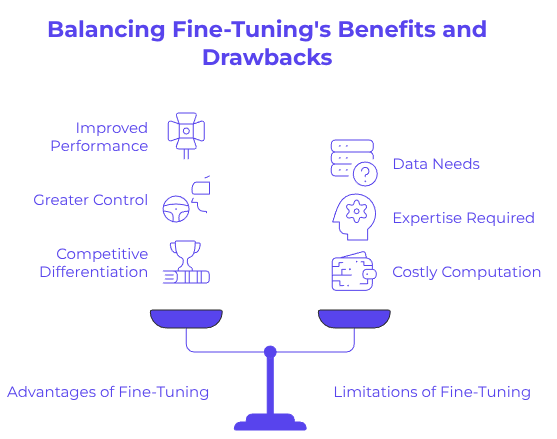
Fine-tuning AI models is a powerful middle ground. Platforms like Hugging Face make this process accessible.This process involves taking a pre-trained model and further training it on your own specific dataset. This adapts the model to your domain, improving its performance on specialized tasks. It’s like teaching an expert a new skill.
Using the participle form, you can say, “Having built a small dataset, we began the fine-tuning process.” Fine-tuning offers a great balance, but it’s important to avoid common mistakes like using too little data or overfitting the model to your examples. Here are the key advantages of fine-tuning:
- Improved performance: Tailors the model to your specific vocabulary and context.
- Greater control: You own the fine-tuned model, giving you more flexibility.
- Competitive differentiation: A fine-tuned model can become a unique asset for your business.
- Cost-effective customization: It’s less expensive than training a new model from scratch.
However, fine-tuning has limitations. It requires a clean, labeled dataset and expertise in machine learning to execute properly. The process can also be computationally intensive, adding to your operational costs.
For deeper implementation guidance, resources like AI SaaS implementation guides can help refine your approach.
Building Custom Foundation Models from Scratch
Building your own model is the most advanced path, often used by companies like DeepMind. To build a foundation model from scratch is the most resource-intensive path, but it offers unparalleled control and customization. This approach is reserved for companies with deep machine learning expertise, massive datasets, and a strategic need for a proprietary model that no off-the-shelf solution can meet.
Once your model is complete, it is a custom-built asset. For example: “Shah Jahan built the Taj Mahal,” and “This house was built before my grandmother’s death.” In the same way, you can say, “Our team built a revolutionary AI from scratch.” This path is right for you if:
- You have a unique, large-scale dataset: Your data is your primary competitive advantage.
- Maximum performance is required: You need to squeeze every bit of accuracy and efficiency out of the model for a specific task.
- You have a long-term strategic vision: The model itself is a core part of your company’s intellectual property.
Building from scratch is a monumental undertaking. It involves immense computational cost, a world-class machine learning team, and a significant time commitment. It’s a high-risk, high-reward strategy that can create a powerful, defensible moat for your business.
Evaluating Cost, Performance, and Scalability
Choosing your path is just the beginning. You must also evaluate how your decision impacts cost, performance, and scalability over the long term. A solution that seems cheap initially might become expensive as you grow, while a high-performance model may be overkill for your immediate needs. The total cost of ownership is a key metric here.
A well-built strategy considers these factors from day one. You need to align your technical approach with your business goals to ensure your AI SaaS is not only powerful but also sustainable. Let’s break down how to assess each of these critical areas.
Comparing Total Cost of Ownership for Each Approach
The total cost of ownership (TCO) extends beyond initial setup fees. It includes ongoing operational costs, maintenance, and the human resources needed to support your AI solution. Comparing the TCO for buying, fine-tuning, and building is essential for making a sound financial decision. “Built” is always a verb—specifically, the past tense or past participle of “build.” It’s never used as a noun.
Buying has a low upfront cost but can become expensive at scale due to API fees. Fine-tuning adds the cost of data preparation and training runs. To build a model from scratch requires the largest initial investment in talent, data, and computing power, but it can have a lower per-transaction cost in the long run.
Here’s a simplified breakdown of the total cost components:
Approach | Initial Cost | Ongoing Cost | Expertise Required |
|---|---|---|---|
Buy |
Low |
High (Usage-based) |
Low |
Fine-Tune |
Medium |
Medium |
Medium |
Build |
Very High |
Low-Medium |
High |
Assessing Performance and Meeting Business Needs
Performance isn’t just about speed; it’s about how well the AI model helps you meet your business needs. Does it generate accurate content? Does it understand user intent correctly? The right performance level for your SaaS depends entirely on what your customers expect. For some applications, “good enough” is perfect, while for others, state-of-the-art accuracy is non-negotiable.
When assessing performance, you use the present tense: “This model builds strong arguments” or “He builds a successful business.” There are also common idioms, like “Rome wasn’t built in a day,” which means great things take time to create. Another is to “build castles in the air,” which means to make unrealistic plans. These phrases show how the concepts of “build” and “built” are ingrained in how we talk about creation and effort.
Ultimately, your goal is to find the sweet spot between performance and cost. A high-performing but expensive model might not be viable for a low-margin SaaS product.
Continuously test and measure the AI’s output against your key business metrics to ensure it delivers real value.
Managing Growth and Scaling AI SaaS Solutions
As your AI SaaS grows, your needs will change. A solution that works for 100 users might buckle under the pressure of 100,000. Scalability is about ensuring your AI infrastructure can handle increased demand without a drop in performance or a massive spike in costs. A properly built system is designed for growth from the start.
The choice between “build” and “built” doesn’t significantly affect the tone, but it does signal the status of a project. Using “build” (present tense) sounds active and forward-looking, while “built” (past tense) conveys completion and stability. For a scaling discussion, both are relevant. To manage growth effectively, you need to:
- Plan for increased load: Whether you’re using an API or a custom model, understand the breaking points.
- Monitor costs closely: Usage-based pricing can escalate quickly, so keep an eye on your spending.
- Have a flexible architecture: Design your SaaS so you can swap out or upgrade AI models as better options become available.
Your initial choice to buy, fine-tune, or build will heavily influence your scaling strategy. API-based solutions are often easy to scale (if you can afford it), while custom-built models give you more control over infrastructure and efficiency.
Conclusion
In conclusion, choosing the right approach for building AI SaaS with foundation models is crucial for your business success. Understanding when to buy, fine-tune, or build these models can help you leverage their capabilities effectively while balancing cost, performance, and scalability. Each option carries its own set of advantages and limitations, and it’s important to align your decision with your company’s specific needs and goals. By carefully evaluating these factors, you can create a robust AI solution that meets your users’ demands and drives growth. If you’re ready to explore your options further, don’t hesitate to reach out for a consultation!
Contents
Frequently Asked Questions
Most frequent questions and answers
Yes, absolutely. When you fine-tune a model on a dataset with a specific writing style or tone, the model learns to replicate it. A system built this way can generate content that perfectly matches your brand’s voice, making it a powerful tool for maintaining a consistent user experience.