Introduction
Artificial intelligence has moved beyond a buzzword and is now an essential tool for business growth. For small and medium-sized enterprises (SMEs), AI agents are democratizing capabilities that were once reserved for large corporations. These intelligent systems can handle tasks, solve problems, and improve your operations over time. To understand the broader foundation of this technology, see Artificial Intelligence explained.
This guide will walk you through how we built five production-ready agents, offering a blueprint for how you can transform your own business by 2026 and stay ahead of the competition.This guide will walk you through how we built five production-ready agents, offering a blueprint for how you can transform your own business by 2026 and stay ahead of the competition.
Introducing the 2026 AI Agent Blueprint for SMEs
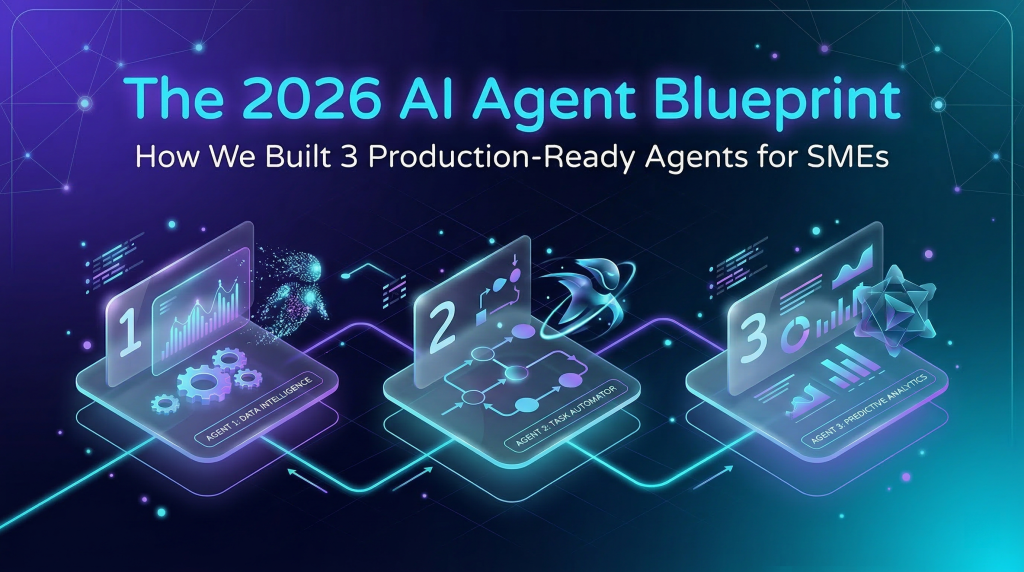
Are you wondering how your small business can build production-ready AI agents by 2026? Our AI agent blueprint is designed to answer that exact question. It provides a clear, step-by-step framework for small businesses to harness the power of agentic AI.
This guide is more than just theory; it’s a practical roadmap based on our experience. We’ll show you how to identify opportunities, select the right tools, and deploy agents that drive tangible business growth and streamline your operations.
Why AI Agents Are Game-Changers for Small and Medium Businesses
For small and medium businesses, AI agents are more than a tech trend—they represent a fundamental shift in operations and competitiveness. By automating repetitive tasks, AI agents free your team to focus on high-value work, dramatically increasing efficiency.
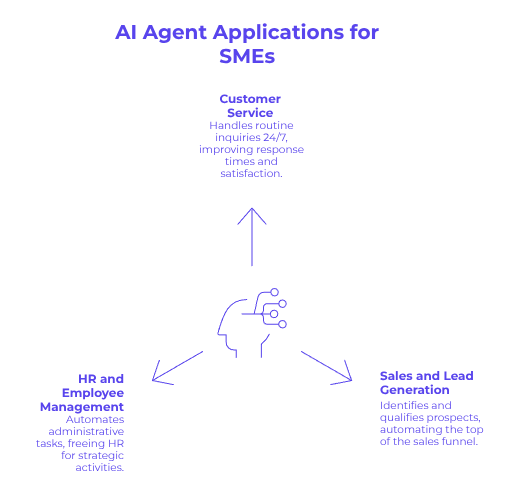
With AI agents, you can offer 24/7 customer support or qualify sales leads without adding staff. The most valuable AI agents for SMEs in 2026 will target key areas such as:
- Customer Service: Instantly handling routine inquiries to boost satisfaction.
- Sales and Lead Generation: Automating outreach and qualifying leads.
- Administrative Tasks: Managing schedules and paperwork automatically.
Integrating these tools lets you compete on experience and efficiency, leveling the playing field with larger companies.
How AI Agents Are Transforming SME Operations in the United States
AI adoption is transforming how U.S. small and medium-sized businesses operate. Business owners are using AI agents to boost customer experience and cut costs by automating tasks like answering questions and processing invoices.
This allows SMEs to offer faster, more personalized service. AI can respond instantly to customer inquiries around the clock, improving satisfaction and freeing staff to focus on complex issues.
According to the U.S. Chamber of Commerce research on AI adoption, 75% of small businesses using AI report higher revenue. Improved efficiency and scalable operations make AI a key driver of growth for modern SMEs.
The Rise of Production-Ready AI Agents in 2026
The year 2026 marks a turning point for production-ready AI agents. These are not experimental bots but robust, reliable systems designed to integrate seamlessly into your daily business workflows. Modern AI systems often rely on advanced models such as those described in OpenAI research on large language models, which enable machines to understand context and generate human-like responses.
Creating an AI agent blueprint for your business involves defining what “production-ready” means for your specific needs and understanding the emerging trends that make these tools so powerful. We’ll explore these concepts in the following sections.
Defining Production-Ready AI Agents
A production-ready AI agent is an autonomous system that understands context, learns from interactions, and makes decisions to complete tasks—unlike basic chatbots limited by scripts.
These systems are built on technologies such as machine learning and natural language processing, explained in IBM’s guide to artificial intelligence technologies.
To qualify as “production-ready,” an AI agent must:
- Reliability: Consistently performs tasks accurately.
- Integration: Seamlessly connects with existing business systems like CRM or accounting software.
Ultimately, a production-ready AI agent is a dependable automation asset that works alongside your team to boost efficiency, drive results, and tackle complex tasks with minimal oversight.
Emerging Trends Driving AI Adoption Among SMEs
Several powerful trends are accelerating AI adoption among small and medium-sized enterprises. The accessibility of cloud-based platforms has eliminated the need for expensive on-site infrastructure, making powerful AI tools available to businesses of all sizes. This democratization is a key driver of business growth.
Two major technological shifts are at the forefront of this movement. These trends are not just for large corporations; they offer practical, high-impact solutions for deploying enterprise-ready agents in a small business environment.
- Generative AI: Businesses are increasingly leveraging tools based on Generative AI technology to automate content creation and marketing workflows.
- Advanced Data Analysis: Modern AI agents can perform sophisticated data analysis, uncovering insights from your business data to inform strategic planning and improve decision-making.
These technologies, often available through user-friendly platforms, are empowering SMEs to innovate and compete like never before.
Types of AI Agents Most Useful for SMEs
For SMEs, the most valuable AI agents are those that tackle high-volume, repetitive tasks, freeing up your team for more strategic work. The best use cases deliver a clear and immediate return on investment by boosting operational efficiency.
From handling customer support to generating sales leads, different types of agents serve specific business needs. In the sections below, we will explore some of the most impactful categories of AI agents and how you can leverage various AI agent platforms to implement them.
Customer Service Automation Agents
AI agents are a powerful tool for small business customer service. They can handle high volumes of routine inquiries 24/7, speeding up response times and boosting customer satisfaction. This allows your human team to focus on complex or sensitive issues.
Trained on your business data—like FAQs and product info—AI agents deliver accurate, context-aware answers. For example, an e-commerce store running on Shopify eCommerce platform could deploy AI agents to answer questions about order status, returns, and shipping.
Benefits include:
- Immediate responses and shorter wait times
- Reduced workload for human staff
- Consistent, accurate information
Automating these tasks cuts costs and enhances the customer experience, helping build loyalty.
Sales and Lead Generation Agents
AI sales agents streamline lead generation by automating tasks like identifying and qualifying prospects.
For instance, many businesses integrate AI tools directly into CRM platforms such as Salesforce CRM system to track leads and automate customer interactions.
By handling initial outreach and data entry, AI agents increase the number of qualified opportunities and shorten the sales cycle.
For example, an AI agent can recognize target company visitors, start conversations, and book demos directly on your team’s calendar. This automates the top of your sales funnel, allowing your team to focus on genuinely qualified leads.
By handling initial outreach and data entry, AI agents increase the number of qualified opportunities and shorten the sales cycle. Your sales team can then concentrate on building relationships and closing deals—driving business growth.
HR and Employee Management Superagents
In 2026, AI superagents will transform HR by automating a wide range of administrative and operational tasks. Unlike basic automation, these advanced agents can manage complex processes such as sourcing candidates, screening resumes, and coordinating onboarding.
For instance, an HR superagent can review thousands of resumes, select top candidates based on set criteria, and schedule interviews. This automation frees your HR team to focus on high-value activities like in-depth interviews, nurturing company culture, and talent development.
These systems can also connect with collaboration tools like Slack workplace communication platform to answer employee questions or process internal requests automatically.
Superagents also handle internal requests, answer questions about benefits and policies, and process routine paperwork. By integrating AI superagents, your HR department becomes more strategic, efficient, and responsive to employee needs.
Technologies Behind Enterprise-Ready AI Agents
Deploying enterprise-ready AI agents no longer requires a team of data scientists. Top platforms provide integrations with major business tools like HubSpot CRM platform and accounting software such as QuickBooks accounting software. The technologies powering these tools have become incredibly accessible, thanks to a new generation of AI platforms and agent platforms designed for business users. These platforms provide the foundation for successful AI implementation.
To achieve effective business automation, it’s crucial to choose the right technologies. The following sections will cover the key platforms and tools available to SMEs, best practices for deployment, and how to integrate these agents into your existing systems.
Key AI Platforms and Tools for SMEs
For SMEs, selecting the right AI platforms is crucial for success. The market offers a range of options, from comprehensive agent platforms to specialized tools for specific small business applications. Fortunately, many of these are designed for users without technical expertise, making them easy to adopt. Yes, there are even free tools to help you get started.
You can find both commercial tools with advanced features and free tools that are perfect for experimenting and handling simpler tasks. For example, a platform like Jasper AI excels at content generation for a monthly fee, while other tools might offer a free tier for basic chatbot functionality.
Here is a look at some popular platforms and their primary uses:
Tool/Platform | Primary Use | Type |
|---|---|---|
Rhino Agents |
Custom customer service agents |
Commercial |
Drift |
Sales & lead qualification |
Commercial |
Jasper AI |
Marketing & content creation |
Commercial |
Reclaim.ai |
Administrative & scheduling assistant |
Free And Commercial |
Xero with Hubdoc |
Financial & accounting automation |
Commercial |
Best Practices for AI Agent Deployment
Successful AI agent deployment goes beyond just choosing a tool. Following best practices ensures that your AI implementation delivers real value and an excellent return on investment. The first step in any AI agent blueprint is to start with a clear, well-defined problem you want to solve. Don’t adopt AI for the sake of it; identify a specific, repetitive process that is consuming too much time.
Data quality is another critical factor. Your AI agent is only as good as the data it’s trained on. Ensure that the information you provide is accurate, up-to-date, and comprehensive. This is especially important for customer-facing agents that rely on your knowledge base.
To ensure smooth business automation, follow these guidelines:
- Start Small: Begin with a single, high-impact use case. Master it before expanding to other areas.
- Set Clear Metrics: Define what success looks like before you start. Measure metrics like time saved or customer satisfaction.
- Involve Your Team: Train your employees on how to use the new tools and gather their feedback for continuous improvement.
Integrating AI Agents with Existing Business Systems
To maximize effectiveness, AI agents must be integrated with your existing business systems. Agents that operate in isolation add more work than they save. Integration enables seamless information flow and allows agents to perform tasks across multiple applications—for example, letting a sales agent write notes directly into your CRM.
Top agent platforms provide pre-built integrations with tools like Shopify, QuickBooks, Slack, and HubSpot. This makes connecting your accounts easy and code-free. Such interoperability is essential for powerful, automated workflows.
Secure data handling is crucial during integration. Ensure sensitive information transfers safely and that the agent has proper permissions to access or modify data. When done right, integrating AI agents creates a unified, intelligent ecosystem that streamlines operations.
Real-World Examples: Five Successful AI Agents for SMEs
Theory is great, but real-world examples show the true power of AI agents for small businesses. We’ve built and deployed five production-ready agents that are already delivering tangible results. These use cases demonstrate how AI can be applied to solve common challenges faced by SMEs.
Each of these agents was built using reliable data sources and tailored to a specific business need. From automating finances to streamlining marketing, these examples provide a practical look at how you can implement similar solutions in your own business.
Case Study: AI Agent for Automating Invoicing
One of the most impactful real-world use cases for AI agents is automating invoicing. For many small businesses, financial management tasks like creating, sending, and tracking invoices are manual, time-consuming, and prone to error. An AI agent can completely transform this process.
We developed an AI agent that integrates with a company’s accounting software and project management tool. When a project is marked as complete, the agent automatically generates an invoice with the correct line items, rates, and client details. It then sends the invoice to the client and sets a reminder for follow-up.
This automation of routine tasks saved the business owner over 10 hours per month. It also improved cash flow by ensuring invoices were sent out promptly and follow-ups were never missed. This is a perfect example of how AI agents can take over repetitive but critical business functions.
Case Study: AI Agent for Marketing Campaigns
AI agents add significant value to marketing, especially for SMEs with small teams overwhelmed by content demands. We developed a marketing AI agent to automate key tasks like content creation and social media posting.
Trained on the client’s brand voice, the agent produced blog drafts, promotional emails, and multiple social posts from a single topic. This enabled the marketing manager to generate five times more content without extra effort, freeing them up to focus on strategy and audience engagement.
This example demonstrates how AI can dramatically boost your marketing productivity.
Case Study: AI Agent for Scheduling and Calendar Management
Scheduling and calendar management often consume hours each week for business owners. To address this, we implemented an AI agent as an intelligent scheduling assistant, demonstrating how AI can handle complex administrative tasks.
The agent integrates with calendars, email, and task management tools. It finds optimal meeting times, protects “focus time,” and automatically reschedules appointments when conflicts occur. The user simply states their needs, and the agent manages the rest.
This automation allowed the business owner to reclaim nearly eight hours per week. Instead of endless emails to set meetings, they relied on the AI to manage their calendar—showcasing how AI can take over small but time-consuming tasks that distract from strategic work.
Beginner’s Guide: Building Production-Ready AI Agents for Your SME
Ready to build your first AI agent? This beginner’s guide provides a clear, step-by-step framework to help you get started with business automation. You don’t need a technical background to follow along; the key is to start with a clear plan and take it one step at a time.
This section will walk you through the essential requirements, the process of identifying suitable tasks for automation, and a simple guide to creating your first agent. This is the core of our AI agent blueprint.
Essential Requirements and Resources to Get Started
Before building AI agents, gather essential resources. You don’t need a large budget or IT department—just a clear understanding of your business processes and the right tools.
Your most important resource is data: customer support logs, sales records, FAQs, or product documents. Well-organized, high-quality data is crucial for training effective agents.
Key resources include:
- A Defined Use Case: A specific, repetitive task to automate.
- Relevant Data Sources: Information the agent needs to learn and operate.
Choose an AI agent platform—many are user-friendly and offer free trials, so you can start without major investment.
Step-by-Step Guide to Creating Your First AI Agent
Creating your first AI agent is easier than you might think. This step-by-step guide breaks down the process into manageable actions, forming the practical part of your AI agent blueprint. The goal is to start with a simple, achievable project to build your confidence and understanding.
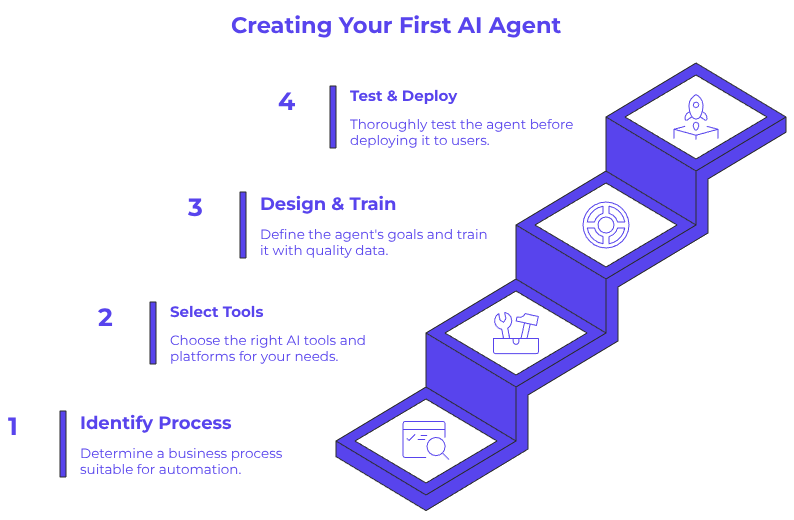
The journey from idea to a functioning AI agent involves a few key stages. You’ll start by identifying a problem, then choose your tools, and finally, bring your agent to life through design and training. This structured approach helps ensure you create an agent that provides real value.
Here are the main steps to follow:
- Step 1: Identify a business process that is suitable for automation.
- Step 2: Select the right AI tools and platforms for your needs and budget.
- Step 3: Design, train, and test your AI agent before deploying it.
Following this path will set you up for successful workflow automation.
Step 1: Identifying Business Processes Suitable for Automation
The first step is to identify which business processes are best suited for automation. Not every task is ideal for AI agents—the best candidates are repetitive, rules-based, and time-consuming activities that don’t require complex thinking.
Start by listing routine tasks like customer support, data entry, scheduling, or social media posting. Prioritize those that are simple yet would save significant time if automated. For example, answering the same customer questions daily is a strong candidate.
Focus on high-impact, low-complexity tasks first. Automating these will quickly demonstrate the value of AI to your team and build momentum for larger projects later.
Step 2: Selecting the Right AI Tools and Platforms
After identifying a process to automate, choose an AI tool that fits your needs and budget. For small businesses, look for user-friendly, no-code platforms with transparent pricing.
When evaluating options, consider ease of use, integration with existing tools, and customer support. Take advantage of free trials to test how well the platform fits your workflow.
Key tips:
- Match Your Use Case: Select a platform tailored to your specific task (e.g., customer service, content creation).
- Check Integrations: Make sure it connects smoothly with your current business tools.
Choosing the right platform is essential for successful AI adoption and maximizing ROI.
Step 3: Designing, Training, and Testing Your AI Agent
With your process identified and platform selected, you’re ready for the final step: designing, training, and testing your AI agent.
Designing means defining the agent’s goals, personality, and steps for completing tasks. For a customer service agent, specify the questions it can answer and when to escalate to a human.
Training focuses on data quality. Provide resources like FAQs, product manuals, or past support tickets—the better the data, the smarter your agent. Most platforms make this easy by letting you upload documents directly.
Finally, always test thoroughly before deployment. Challenge your agent with varied questions and scenarios to find its limits. This helps you refine its performance and ensure it’s ready for real users.
Overcoming Challenges in AI Agent Development
Building AI agents is not without its challenges. From technical hurdles to team adoption, businesses often face obstacles during AI implementation. Common issues include dealing with poor data quality, managing limited resources, and navigating data privacy concerns.
However, these challenges are surmountable. Based on the lessons learned from our own deployments, we’ll share insights on how to anticipate these problems and create a smoother path to success. The following sections will detail common pitfalls and how to avoid them.
Common Pitfalls When Building AI Agents
When building AI agents, small businesses often encounter a few common pitfalls that can derail their progress. One of the biggest challenges is starting with unrealistic expectations. An AI agent won’t solve all your business problems overnight. It’s a tool that requires careful implementation and refinement to deliver results.
Another major issue is poor data quality. Many businesses feed their agents incomplete or outdated information, leading to poor performance and inaccurate responses. Remember, your AI agent is a reflection of the data it’s trained on. Garbage in, garbage out.
To avoid these problems, be aware of these pitfalls:
- Trying to Automate Too Much, Too Soon: Start with one simple, well-defined task. Trying to build a super-agent that does everything at once often leads to a system that does nothing well, especially with limited resources.
- Neglecting the Human Element: Don’t forget to train your team on how to work with the new agent. A lack of adoption can make even the best tool useless.
Data Privacy and Security Considerations
To ensure AI agent security and privacy, small businesses must prioritize data protection. Since AI agents handle sensitive information, breaches can have serious consequences. Before selecting a platform, review its data handling policies—know where your data is stored, who can access it, and how it’s used. Check if your data will be used to train general models and confirm compliance with regulations like GDPR or HIPAA.
Choose providers with strong security features such as encryption and multi-factor authentication. Establish internal data security policies and train employees on best practices for handling sensitive information within AI systems. Proactive measures help build customer trust and protect your business from potential risks.
Lessons Learned from Deploying Five AI Agents
Deploying five distinct AI agents has taught us some invaluable lessons. The most important takeaway is that successful AI implementation is an iterative process. You don’t just set it and forget it. The best results come from continuous monitoring, testing, and refinement based on real-world performance.
We also learned the importance of managing scope. Our most successful projects were those that started with a very specific, narrow goal. For example, instead of building an agent to “handle all marketing,” we built one to “draft social media posts from blog content.” This focused approach to workflow automation ensures you create a tool that excels at its job.
Finally, celebrating small wins is key to driving adoption and business growth. When an agent successfully saves time or improves a metric, share that success with your team. This builds enthusiasm and demonstrates the tangible value of AI, encouraging everyone to embrace the new technology.
Monetizing AI Agents as a Digital Agency in 2026
If you run a digital agency, you’re likely wondering, “How can I make money using AI agents?” The rise of AI automation presents a massive opportunity for agencies to create new revenue streams and deliver more value to clients. By 2026, offering AI solutions will be a key differentiator.
You can move beyond traditional services and start monetizing your expertise in building and managing AI agents. This positions your agency as a forward-thinking partner dedicated to driving real business growth for your clients. The following sections will explore how to do just that.
Offering AI Solutions to Local Businesses
Agencies are well-positioned to offer AI solutions to local businesses, many of which lack the time or expertise to implement these tools. Start by identifying common pain points among your clients—for example, after-hours customer support or missed website leads.
Package your services as an “AI-in-a-box” solution that includes building, deploying, and maintaining an AI agent for a specific need. Examples include:
- A customer support agent for restaurants to handle reservations and menu questions
- A lead qualification agent for contractors to capture leads 24/7
- A scheduling agent for salons or spas to automate appointments
Offering these managed AI services creates recurring revenue for your agency while delivering valuable solutions to local businesses competing in a digital world.
Scaling Your Agency with AI Automations
Beyond offering AI services to clients, a digital agency can use AI agents to scale its own operations. By implementing business automation internally, you can handle more clients and projects without proportionally increasing your headcount. This is the key to profitable scaling in 2026.
Consider the repetitive tasks within your own agency. AI agents can automate client reporting, draft initial proposals, manage social media for your own brand, and even handle first-level client inquiries. This frees up your team to focus on high-value strategic work, client relationships, and creative problem-solving.
Implementing AI automation internally also serves as a powerful case study. When you can show potential clients exactly how you’ve used AI to improve your own efficiency and results, it becomes a much more compelling sales pitch. You’re not just selling a service; you’re selling a proven methodology for business growth.
Leveraging Free and Affordable AI Tools for Maximum ROI
You don’t need expensive software to maximize ROI with AI tools. Many free or low-cost platforms are ideal for agencies and small businesses.
Free AI tools are great for proof-of-concept projects and simple automation. For example, use a free chatbot builder to create a basic customer service agent. Once you show value, upsell clients to more advanced solutions.
To boost your ROI:
- Start with Free Tiers: Test ideas risk-free using free AI tools.
- Automate High-Impact Tasks: Focus on affordable platforms that save time or drive revenue.
This strategy delivers strong results for clients while keeping costs low, increasing your agency’s profit margins.
Conclusion
In conclusion, the 2026 AI Agent Blueprint represents a significant shift in how small and medium enterprises can leverage technology to optimize their operations. By embracing production-ready AI agents, businesses stand to enhance efficiency, improve customer interactions, and scale operations effectively. The case studies illustrate not just the potential for automation but also practical applications that deliver real results. As you embark on this journey, remember that understanding the challenges and the technologies available is key to success. If you’re ready to take your SME to the next level with AI, don’t hesitate to reach out for expert guidance and support.
Contents
Frequently Asked Questions
Most frequent questions and answers
CTOs should budget for the cost of specialized security tools, ongoing training for their teams, and potentially hiring staff with expertise in AI safety. While there is an upfront investment, implementing AI safety guardrails in 2026 for your RAG systems ultimately delivers business value by reducing compliance risks and building trust in your enterprise AI.
Enterprises can measure effectiveness by tracking Key Performance Indicators (KPIs) like faithfulness and citation coverage. Other metrics include the rate of blocked adversarial inputs and the number of data access violations prevented. Establishing user feedback loops also provides qualitative data on the performance of your enterprise AI and helps improve business outcomes.
CTOs should prioritize a mix of skills. This includes technical expertise in AI security and vector databases, as well as governance knowledge of data privacy and risk management. Investing in training for continuous monitoring and ethical AI principles is also critical for building and maintaining effective AI guardrails.
CTOs ensure compliance by integrating AI safety into their governance frameworks. This involves mapping regulatory requirements, implementing programmable policies, and maintaining detailed audit trails of AI behavior. A proactive approach, focusing on transparency and accountability, is key to meeting compliance standards for RAG models by 2026.